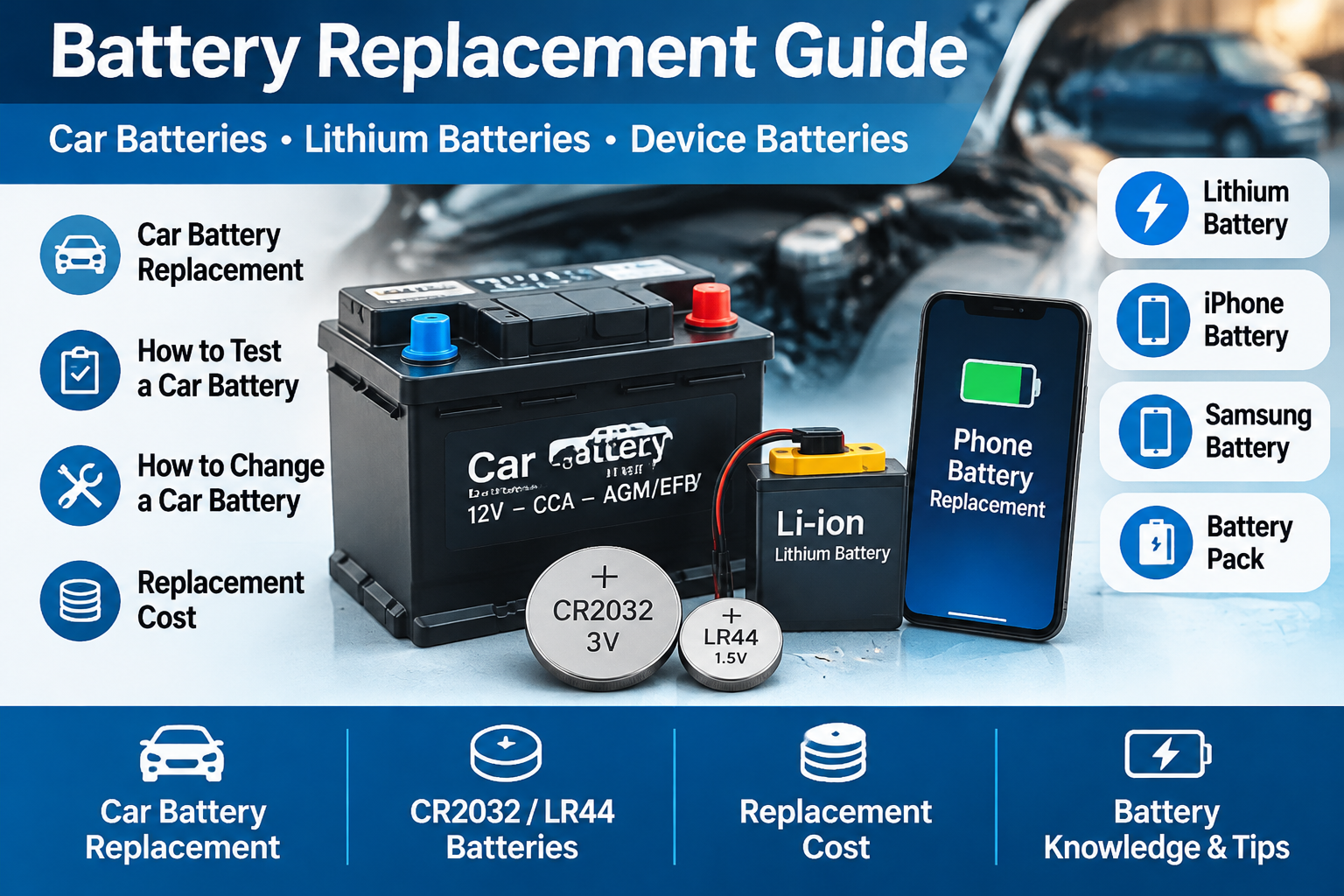


What Is a Battery? A Complete Guide to Battery Types, Sizes, Charging, Lifespan and Applications
A battery is one of the most important parts of modern electronic equipment. From smartphones and laptops to electric vehicles, solar energy systems, industrial machines, and small medical devices, batteries provide the energy that allows equipment to operate without a continuous connection to an external power supply.
Most people think about batteries only when their phone runs out of power or their car fails to start. However, a battery is much more than a simple energy source. Its chemistry, size, voltage, internal resistance, charging behavior, and operating temperature can directly influence the performance and reliability of an entire electronic system.
A larger battery does not always provide a better experience, and a battery with a higher voltage is not necessarily more powerful. The best battery is the one that matches the electrical requirements, operating environment, and expected service life of the device.
This guide explains how batteries work, compares popular battery types, and explores practical ways to select, recharge, maintain, and replace batteries in everyday and industrial applications.
1. What Is a Battery?
A battery is an electrochemical device that stores chemical energy and converts it into electrical energy when connected to a circuit. It provides direct current, commonly known as DC power, to electronic and electrical equipment.
A battery may contain a single electrochemical cell or several cells connected together. The number of cells and their connection method determine the overall voltage and capacity.
For example, a small watch battery may contain only one cell, while a laptop battery pack contains multiple rechargeable cells. An electric vehicle battery may contain hundreds or thousands of cells working together.
Most conventional batteries contain several essential elements:
- Anode: The electrode where oxidation occurs during discharge.
- Cathode: The electrode where reduction occurs during discharge.
- Electrolyte: A material that allows ions to move between electrodes.
- Separator: A material that prevents direct electrical contact between the electrodes while allowing ion movement.
- Terminals: External connections that deliver electrical power to a circuit.
- Protective housing: A structure that protects the internal materials.
The purpose of every battery is similar, but differences in chemical materials and construction create different voltage levels, energy capacities, charging requirements, and operating characteristics.
In simple terms: A battery stores energy in chemical form and supplies electrical energy when a connected device needs power.
2. How Does a Battery Work?
When a battery is connected to an electrical circuit, chemical reactions inside its cells create a difference in electrical potential between its terminals.
During discharge, electrons move through the external circuit from the negative terminal toward the positive terminal. At the same time, ions move through the electrolyte inside the battery. These processes allow electrical energy to reach the connected device.
For example, when a battery powers a flashlight, electrical energy flows through the circuit and allows the LED to produce light. As the chemical reactions continue, the available stored energy gradually decreases.
A rechargeable battery works differently from a disposable battery because an external power source can reverse much of its internal chemical reaction. This process restores stored energy and allows the battery to operate again.
Battery Discharge and Charging Process
One important detail is that batteries do not deliver perfectly constant performance. Their terminal voltage can change depending on temperature, load current, state of charge, and internal resistance.
This is why many battery powered devices require a power management circuit to provide stable voltage to sensitive electronic components.
3. Main Types of Batteries
Batteries can be divided into two main categories: primary batteries and secondary batteries.
Primary Batteries
Primary batteries are designed for single-use operation. Once their stored chemical energy is depleted, they should be replaced and disposed of or recycled according to local requirements.
Common examples include alkaline batteries, zinc-carbon batteries, silver oxide batteries, and non-rechargeable lithium batteries.
These batteries are often used in remote controls, clocks, small sensors, calculators, watches, and other devices with relatively low energy consumption.
Secondary Batteries
Secondary batteries are rechargeable. Their chemical structure allows them to store energy repeatedly when connected to a suitable charging system.
Common rechargeable battery technologies include lithium-ion, lithium iron phosphate, nickel-metal hydride, nickel-cadmium, and lead-acid batteries.
| Battery Type | Nominal Cell Voltage | Rechargeable | Common Applications |
|---|---|---|---|
| Alkaline | 1.5V | No, for standard alkaline cells | Remote controls, clocks, toys |
| Zinc-Carbon | 1.5V | No | Low-power household devices |
| Silver Oxide | 1.55V | Normally no | Watches and measuring instruments |
| Lithium Coin Cell | 3V for common CR cells | No, for standard CR cells | Computer RTC, sensors, key fobs |
| NiMH | 1.2V | Yes | Rechargeable household batteries |
| Lithium-Ion | 3.6V–3.7V commonly | Yes | Phones, laptops, portable devices |
| LiFePO4 | 3.2V | Yes | Solar storage and electric equipment |
| Lead-Acid | 2V | Yes | Cars, UPS and backup power |
The choice between disposable and rechargeable batteries should depend on how often the device is used, its energy requirements, maintenance costs, and environmental conditions.
A rechargeable battery may offer better long-term value for a device used every day. However, a primary battery with low self-discharge may be more convenient for equipment that operates only occasionally.
4. Battery Size and Voltage: AA, AAA, 9V and 12V Batteries
Battery size is an important selection factor because it determines whether a battery physically fits into a device. However, physical size and electrical performance are not the same thing.
Two batteries with identical dimensions can have different chemical compositions, voltages, capacities, and discharge characteristics.
| Battery Size | Common Nominal Voltage | Approximate Dimensions | Typical Use |
|---|---|---|---|
| AAA | 1.5V alkaline | 10.5 × 44.5mm | Remote controls and small electronics |
| AA | 1.5V alkaline | 14.5 × 50.5mm | Toys, wireless accessories |
| C | 1.5V alkaline | 26.2 × 50mm | Flashlights and portable equipment |
| D | 1.5V alkaline | 34.2 × 61.5mm | Larger flashlights and radios |
| 9V Battery | 9V for standard alkaline types | Approximately 48.5 × 26.5 × 17.5mm | Alarms, meters and electronic instruments |
| CR2032 | 3V | 20 × 3.2mm | RTC circuits and small sensors |
| 18650 | 3.6V–3.7V commonly | 18 × 65mm nominal | Lithium-ion battery packs |
| 21700 | 3.6V–3.7V commonly | 21 × 70mm nominal | Power tools and energy storage packs |
| 12V Battery | Approximately 12V nominal | Varies by chemistry and design | Vehicles, UPS and solar systems |
What Is a 9V Battery Used For?
A 9V battery is commonly found in certain smoke alarms, digital multimeters, portable test equipment, guitar pedals, and other low-current electronic devices.
Although it provides a higher nominal voltage than an AA battery, its practical energy capacity and current delivery may be lower than expected. A standard alkaline 9V battery is generally not an ideal choice for motors or other high-current loads.
What Is a 12V Battery Used For?
A 12V battery is widely used in vehicles, alarm systems, backup power supplies, recreational equipment, and small solar energy storage systems.
Traditional automotive lead-acid batteries use six cells connected in series to produce approximately 12V. Lithium-based replacement batteries may use different cell arrangements and require different charging systems.
Always confirm battery chemistry, polarity, physical dimensions, current capability, and charging compatibility before replacing a 12V battery.
5. Why Is the Lithium Battery So Popular?
The lithium battery has become an important energy source because lithium-based technologies can store substantial energy in relatively small and lightweight packages.
Rechargeable lithium-ion batteries are particularly suitable for modern electronic products that require mobility, high energy capacity, and repeated charging.
Smartphones, laptops, electric bicycles, portable power stations, wireless headphones, and electric vehicles all benefit from lithium-ion battery technology.
Main Advantages of Lithium-Ion Batteries
- High energy density compared with traditional lead-acid batteries.
- Relatively lightweight construction.
- Low self-discharge compared with some older rechargeable technologies.
- Multiple cell configurations for different voltage and capacity requirements.
- Good charging efficiency when properly managed.
- Suitability for compact electronic products.
However, lithium batteries are not a single technology. Different lithium-based chemical systems offer different strengths.
| Lithium Battery Chemistry | Main Advantage | Common Application |
|---|---|---|
| LCO | High energy density | Consumer electronics |
| NMC | Balance of energy and power | Electric vehicles and power equipment |
| NCA | High specific energy | Selected electric vehicle systems |
| LiFePO4 | Good thermal stability and cycle life | Solar storage and backup power |
| LTO | Fast charging capability and long cycle life | Specialized industrial systems |
A lithium battery must be selected according to the intended application. For example, a smartphone manufacturer may prioritize energy density, while a solar storage system designer may place greater importance on cycle life and thermal stability.
Another important distinction is that some lithium batteries are not rechargeable. Standard CR2032 lithium coin cells, for example, must not be charged.
6. Understanding Battery Capacity, Energy and Power
Battery capacity describes how much electrical charge a battery can deliver under specified conditions. It is commonly measured in ampere-hours (Ah) or milliampere-hours (mAh).
However, capacity alone does not describe the total energy stored inside a battery.
Battery energy is commonly measured in watt-hours (Wh), while power is measured in watts (W).
Battery Energy (Wh) ≈ Nominal Voltage (V) × Capacity (Ah)
Electrical Power (W) = Voltage (V) × Current (A)
Consider the following example:
| Battery | Voltage | Capacity | Nominal Energy |
|---|---|---|---|
| Battery A | 3.7V | 5000mAh | 18.5Wh |
| Battery B | 12V | 5000mAh | 60Wh |
| Battery C | 12V | 10000mAh | 120Wh |
Battery A and Battery B have the same capacity in milliampere-hours, but Battery B has a much higher nominal energy content because its voltage is higher.
This explains why comparing batteries only by their mAh ratings can be misleading.
How Long Can a Battery Power a Device?
A simple runtime estimate can be calculated by dividing available battery energy by average device power consumption.
Estimated Runtime (Hours) = Usable Battery Energy (Wh) ÷ Average Load Power (W)
For example, a battery containing 60Wh of energy could theoretically power a 10W device for six hours.
However, if only 80% of its nominal energy reaches the load because of discharge limits and conversion losses, the estimated runtime becomes 4.8 hours.
Actual runtime also depends on operating temperature, discharge rate, battery age, voltage cut-off limits, and the behavior of the connected device.
For this reason, engineers should focus on usable energy rather than only the capacity printed on the battery label.
7. How to Recharge a Battery Correctly
To recharge a battery, an external power source delivers electrical energy that restores the chemical energy inside rechargeable cells.
Different battery chemistries require different charging methods. A charger designed for one type of battery may damage another type, even when the batteries have similar nominal voltages.
Many lithium-ion battery charging systems use a constant-current and constant-voltage method, commonly called CC/CV charging.
During the constant-current stage, the charger supplies a controlled current while the battery voltage gradually increases. Once the specified charging voltage is reached, the charger maintains that voltage and the charging current decreases.
Charging ends when the appropriate termination conditions are met.
Common Battery Charging Methods
| Battery Chemistry | Typical Charging Method | Important Consideration |
|---|---|---|
| Lithium-Ion | CC/CV | Correct cell voltage and current limits |
| LiFePO4 | Chemistry-specific CC/CV | Different voltage limits from many other lithium-ion cells |
| Lead-Acid | Multi-stage charging | Correct charging profile and temperature conditions |
| NiMH | Controlled current with charge termination | Temperature and voltage monitoring |
Fast charging can be convenient, but charging speed should not be the only priority. Higher charging currents may increase heat and contribute to battery wear, particularly under unsuitable temperature conditions.
Use a compatible battery charger, follow the manufacturer's charging limits, and stop using batteries that show swelling, leakage, unusual heat, or physical damage.
Never attempt to recharge a disposable battery unless it is explicitly designed for rechargeable operation.
8. Phone Battery Technology: Why Smartphone Batteries Lose Capacity
A modern phone battery is usually based on rechargeable lithium-ion technology. Its compact construction provides the energy required by smartphone processors, displays, cameras, wireless communication modules, and other electronic circuits.
However, phone batteries gradually lose capacity as their internal chemical materials age.
Even if two smartphones use batteries with the same capacity, their operating time may be significantly different.
Several factors affect phone battery consumption:
- Display brightness and refresh rate.
- Processor efficiency and workload.
- Wireless signal strength.
- Background application activity.
- GPS, Bluetooth, and cellular communication.
- Software power management.
- Battery temperature and internal resistance.
A smartphone with a smaller battery but a more efficient processor and display may operate longer than another phone with a larger battery.
This is an important example of why battery capacity should be evaluated together with the actual power consumption of a device.
How to Reduce Phone Battery Wear
Avoid unnecessary exposure to high temperatures, use compatible charging accessories, and enable optimized charging features when available.
Keeping a lithium-ion battery near a moderate state of charge when practical may reduce some forms of chemical stress. However, exact charging recommendations depend on the device and battery management system.
There is generally no need to fully discharge a modern lithium-ion phone battery before recharging it.
9. How to Check Laptop Battery Health
Laptop battery health describes the remaining ability of a battery to store energy compared with its original design capacity.
A laptop may display a 100% charge even when its battery has lost a significant portion of its original capacity. This happens because the displayed percentage normally represents the current charge relative to the battery's present usable capacity, rather than its original factory capacity.
How to Check Laptop Battery Health on Windows
- Open Windows Command Prompt or Windows Terminal.
- Enter the following command:
powercfg /batteryreport- Locate the battery report file using the path displayed by Windows.
- Open the report in a web browser.
- Find Design Capacity and Full Charge Capacity.
- Compare the two values to estimate remaining battery capacity.
Estimated Battery Health (%) = Full Charge Capacity ÷ Design Capacity × 100
For example, if a laptop battery originally had a design capacity of 60,000mWh and its current full charge capacity is 45,000mWh, its estimated capacity retention is 75%.
How to Check Laptop Battery Health on Mac
On supported macOS versions, open System Settings, select Battery, and locate Battery Health. Additional battery information, including cycle count, may be available in System Information under the Power section.
The exact menu names depend on the macOS version and computer model.
A battery health reading should be treated as an estimate rather than a complete diagnosis. Internal resistance, sudden shutdowns, temperature behavior, and physical condition can also indicate whether a battery needs replacement.
Common Signs of Laptop Battery Degradation
- Operating time becomes noticeably shorter.
- The laptop shuts down unexpectedly while battery charge remains.
- The displayed battery percentage changes rapidly.
- Charging behavior becomes unusual.
- The battery or laptop enclosure shows signs of swelling.
If a laptop battery becomes swollen, stop using and charging the device and arrange professional inspection or replacement.
10. Automotive Battery and Car Battery Systems
An automotive battery provides electrical energy to vehicle systems. In a conventional gasoline or diesel car, the starting battery supplies the high current required by the starter motor and supports electrical equipment when needed.
After the engine starts, the alternator normally supplies electrical power and replenishes the battery under suitable operating conditions.
A traditional 12V automotive battery commonly uses lead-acid chemistry because it can deliver substantial starting current at a practical cost.
Common Types of Car Batteries
| Automotive Battery Type | Main Characteristic |
|---|---|
| Flooded Lead-Acid | Traditional starting battery technology |
| AGM Battery | Good performance for suitable start-stop and high-demand systems |
| EFB Battery | Improved cycling performance over conventional flooded designs |
| Compatible Lithium-Based Battery | Lower weight in selected vehicle applications |
When comparing a battery and car electrical system, voltage alone is not enough. Starting current, reserve capacity, physical size, terminal position, battery technology, and vehicle charging requirements should also be considered.
Cold Cranking Amps, commonly called CCA, is an important rating for many automotive starting batteries because it describes starting-current capability under specified low-temperature test conditions.
Electric vehicles introduce another type of automotive battery: the high-voltage traction battery. Unlike a conventional starting battery, the traction battery stores the energy used to drive the electric motor.
Many electric vehicles also have a separate low-voltage battery for electronic control and auxiliary systems.
11. How to Choose a Car Battery Charger
A car battery charger restores stored energy to a compatible automotive battery. It can be useful when a vehicle is stored for extended periods, used mainly for short trips, or affected by an electrical discharge problem.
A suitable charger must match the battery's chemistry, voltage, capacity, and recommended charging requirements.
Important Features of a Car Battery Charger
- Compatibility with the battery's nominal voltage.
- Support for the correct battery chemistry.
- Automatic charging control.
- Suitable charging current.
- Reverse-polarity protection.
- Overvoltage and short-circuit protection.
- Maintenance charging when supported.
- Temperature compensation where appropriate.
A battery charger and a jump starter serve different purposes. A charger restores battery energy over time, while a jump starter provides temporary assistance for starting a compatible vehicle.
If a car battery repeatedly loses charge, the problem may not be the battery itself. A faulty alternator, unwanted electrical current, damaged connections, or other electrical system problems may also be involved.
Follow both the vehicle manual and charger instructions. Do not attempt to charge a frozen, leaking, swollen, or physically damaged automotive battery.
12. Solar Battery: How Solar Powered Energy Storage Works
A solar battery stores electrical energy generated by solar panels so that the energy can be used later.
Solar panels produce electricity when sufficient sunlight is available. However, electricity demand does not always match sunlight availability. A battery allows part of the available energy to be stored for nighttime use or periods of reduced solar generation.
A typical DC-coupled solar battery system includes solar panels, a charge controller, battery storage, protection circuits, and an inverter when AC power is required.
Lead-acid batteries have traditionally been used in off-grid solar installations. Lithium iron phosphate batteries are also widely considered for stationary energy storage because of their cycling performance and thermal characteristics.
How to Calculate Solar Battery Size
Solar battery size depends on daily energy consumption, backup duration, usable depth of discharge, system efficiency, and battery voltage.
For example, if a small electronic system consumes 100W continuously for five hours, its energy requirement is 500Wh.
If the battery provides 80% usable depth of discharge and the system operates at 90% energy delivery efficiency, the estimated nominal battery energy requirement is:
500Wh ÷ (0.8 × 0.9) ≈ 694Wh
This simplified example shows that selecting a battery rated at exactly 500Wh may not provide the required operating time.
A well-designed solar powered system should also consider seasonal sunlight, charging availability, battery aging, installation conditions, and backup energy requirements.
13. Electronic Components Used in Modern Battery Systems
A battery rarely operates alone in a modern electronic product. It depends on several semiconductor devices and supporting components to manage energy safely and efficiently.
From an electronic engineering perspective, battery performance is determined not only by the cell but also by the quality of the power management circuit surrounding it.
| Electronic Component | Function in Battery Systems | Example Application |
|---|---|---|
| Battery Charger IC | Controls charging voltage and current | Phone and portable device charging |
| Battery Management IC | Monitors and manages battery operating conditions | Multi-cell battery packs |
| Microcontroller | Processes data and executes control functions | Intelligent energy management |
| MOSFET | Controls charging and discharging current paths | Battery protection and switching |
| DC-DC Converter | Converts battery voltage to the required supply voltage | Embedded systems and portable equipment |
| LDO Regulator | Provides regulated low-voltage power | Analog circuits and sensitive sensors |
| Current Sense Resistor | Produces a measurable voltage proportional to current | Charge and discharge measurement |
| Capacitor | Supports voltage filtering and transient response | Power supply stabilization |
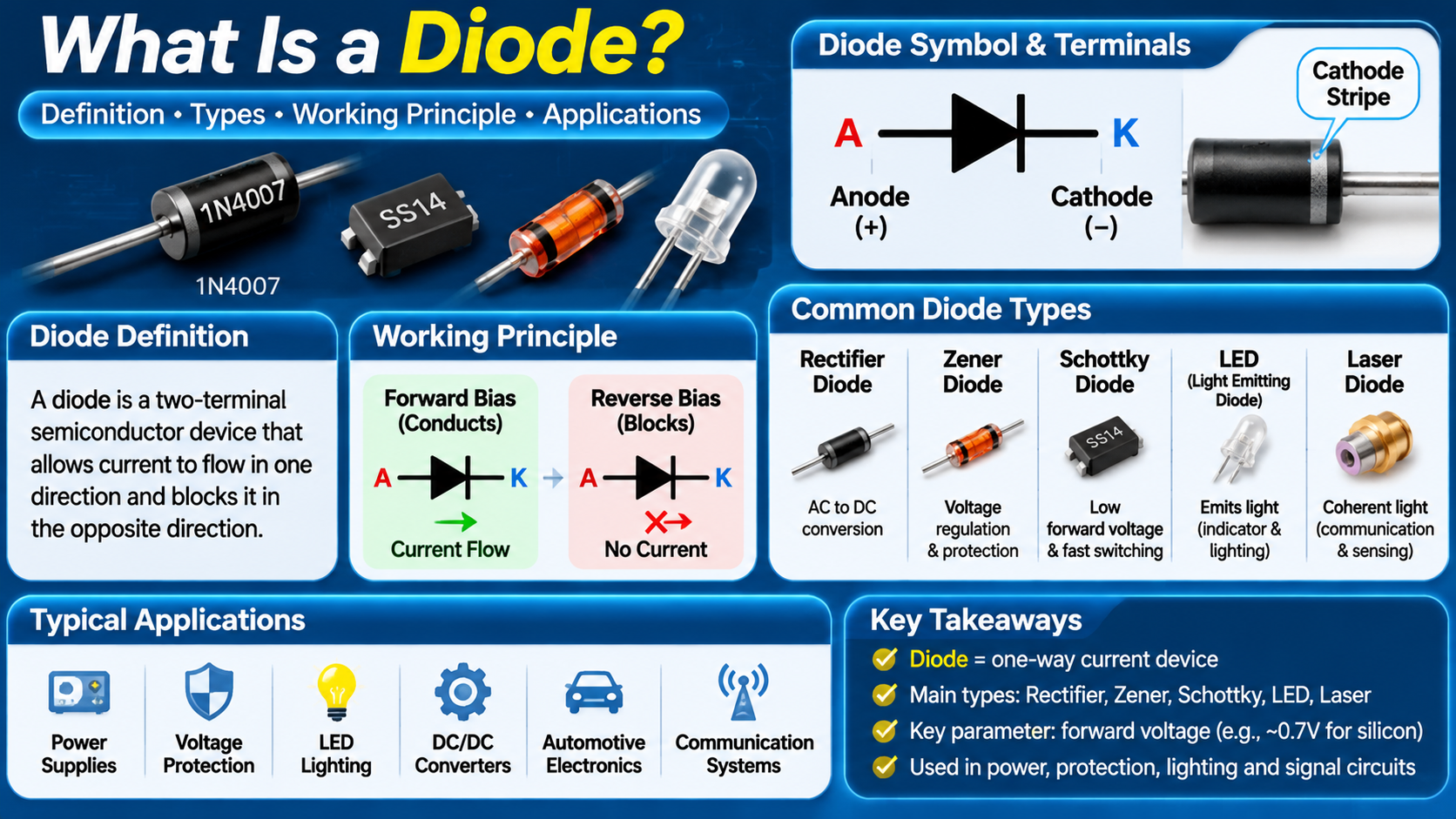
| TVS Diode | Helps protect circuits from transient overvoltage | Automotive and industrial power inputs |
| Fuse | Interrupts excessive current under defined fault conditions | Battery pack and circuit protection |
| Thermistor | Monitors temperature | Battery charging protection |
What Is a Battery Management System?
A battery management system, or BMS, is an electronic system used to monitor and manage rechargeable batteries, particularly those containing multiple cells.
Depending on its design, a BMS can monitor cell voltage, battery current, temperature, state of charge, and fault conditions. Some systems also support cell balancing and communication with other equipment.
Common semiconductor examples include the BQ76930 family for multi-cell battery monitoring, BQ24074 for single-cell lithium-ion charging, and STM32 microcontrollers for embedded control functions.
These devices perform different tasks and should not be treated as interchangeable components. Their suitability depends on the number of cells, voltage range, current requirements, system architecture, and required protection features.
Why Power Management Matters as Much as Battery Capacity
Consider two electronic devices using batteries with the same stored energy. If one device has an inefficient voltage regulator, more battery energy may be converted into unwanted heat instead of useful operating power.
Improving DC-DC converter efficiency, reducing standby current, and placing electronic components into low-power operating modes can extend battery runtime without increasing physical battery size.
This is particularly important in wireless sensors, Internet of Things devices, portable instruments, and battery powered industrial equipment.
Better battery performance is therefore not always achieved by installing a larger battery. Sometimes, the more effective solution is to improve how the electronic circuit uses energy.
14. Battery Powered Devices and Everyday Applications
Battery powered devices have become essential in daily life because they allow electronic equipment to operate independently of fixed electrical connections.
However, different applications require different battery characteristics.
| Application | Common Battery Technology | Primary Design Priority |
|---|---|---|
| Smartphones | Lithium-Ion | Energy density and compact size |
| Laptops | Lithium-Ion | Runtime and charging management |
| Watches | Silver Oxide or Lithium | Small size and low self-discharge |
| Remote Controls | Alkaline or NiMH | Long storage and operating life |
| Automotive Starting | Lead-Acid or AGM | High starting current |
| Solar Energy Storage | LiFePO4 or Lead-Acid | Cycle life and storage capacity |
| Electric Power Tools | Lithium-Ion | High discharge power |
| IoT Sensors | Primary Lithium or Rechargeable Cells | Low standby energy consumption |
| Industrial Backup Power | Lead-Acid or Lithium-Based Packs | Reliability and backup duration |
A battery designed for a wristwatch may provide power for a long period because the watch consumes very little current. In contrast, a battery used in a power tool must deliver substantial electrical current for short periods.
Neither battery is inherently better. Each is designed to solve a different energy delivery problem.
15. What Affects Battery Lifespan?
Battery lifespan refers to the period during which a battery continues to meet the performance requirements of its intended application.
Rechargeable battery life is commonly described using two related concepts: cycle life and calendar life.
Cycle life refers to the number of equivalent charge and discharge cycles a battery can experience before reaching a defined degradation limit. Calendar life refers to aging over time, even when the battery is rarely used.
Major Factors That Affect Battery Life
- Temperature: Excessive heat can accelerate chemical degradation.
- Charging Voltage: Inappropriate charging voltage can damage battery materials.
- Discharge Depth: Repeated deep discharge may increase wear in certain battery technologies.
- Charge and Discharge Current: High currents can increase heat and internal losses.
- Storage Conditions: Temperature and state of charge during storage influence aging.
- Manufacturing Quality: Material quality and cell consistency affect reliability.
- Power Management: Efficient circuits and suitable protection systems help maintain appropriate operating conditions.
One commonly overlooked issue is internal resistance. As some batteries age, their internal resistance increases, causing greater voltage drop when current is drawn.
A degraded battery may still provide acceptable performance under a light load but fail when a device suddenly requires higher current.
This is why a battery capacity test alone may not reveal every performance problem.
Typical Battery Service Life Considerations
| Battery Application | Illustrative Service Life | Main Influencing Factors |
|---|---|---|
| Phone Battery | Often several years | Charging habits, temperature and usage |
| Laptop Battery | Often several years | Cycles, heat and charging conditions |
| Automotive Lead-Acid Battery | Commonly around 3–5 years | Climate, driving patterns and charging |
| Watch Battery | Often one to several years | Watch design and energy consumption |
| Stationary LiFePO4 Battery | Potentially many years | System design, cycling and temperature |
These service life descriptions are general estimates rather than guaranteed figures. Actual performance depends on the specific battery model, manufacturer specifications, operating conditions, and replacement criteria.
16. How to Choose the Right Battery
Selecting a battery should begin with the requirements of the device rather than the largest capacity or lowest purchase price.
A practical battery selection process includes the following steps.
- Identify the required voltage: Confirm the operating voltage range supported by the device.
- Determine power consumption: Estimate both average and peak electrical demand.
- Calculate the required runtime: Determine how long the device must operate between charging or replacement.
- Select the appropriate chemistry: Compare energy density, charging requirements, safety, and operating characteristics.
- Check battery size: Confirm dimensions, terminal arrangement, connector type, and polarity.
- Evaluate operating conditions: Consider temperature, vibration, humidity, and installation environment.
- Review protection requirements: Determine whether charging control, temperature monitoring, and additional circuit protection are required.
- Compare lifetime costs: Include replacement frequency, maintenance, charging efficiency, and equipment downtime.
A Better Way to Compare Battery Cost
The cheapest battery may not be the most economical battery over the lifetime of a product.
For rechargeable energy storage systems, one useful comparison is the estimated purchase cost per unit of energy delivered over the battery's useful life.
For example, consider two hypothetical batteries with the same nominal energy capacity of 1kWh.
| Comparison | Battery A | Battery B |
|---|---|---|
| Purchase Cost | $100 | $180 |
| Assumed Usable Energy per Cycle | 0.8kWh | 0.8kWh |
| Assumed Useful Cycles | 500 | 1500 |
| Estimated Lifetime Energy | 400kWh | 1200kWh |
| Purchase Cost per Delivered kWh | $0.25 | $0.15 |
In this simplified example, Battery B costs 80% more initially but has a 40% lower purchase cost per estimated lifetime kilowatt-hour.
These figures are illustrative rather than actual commercial product specifications. Real calculations should include capacity degradation, charging losses, maintenance, calendar aging, and system costs.
This comparison demonstrates why battery value should be measured by useful performance over time rather than initial purchase price alone.
17. Battery Replacement: What to Know Before Buying a New Battery
When a battery stops providing sufficient operating power, replacement may be necessary. However, purchasing a replacement battery involves more than matching its appearance.
People often use search terms such as "battery near me," "Battery Plus," "car battery replacement," or "watch battery replacement near me" when looking for replacement products and local services.
Before buying a new battery, verify the exact model, nominal voltage, chemistry, dimensions, connector configuration, and application requirements.
Watch Battery Replacement
Watch batteries are commonly available in small silver oxide, alkaline, and lithium coin-cell formats.
Popular battery designations include SR626SW, LR44, and CR2032. These batteries have different dimensions and electrical characteristics and are not universally interchangeable.
For watches with water-resistant construction, professional battery replacement may also help ensure that seals and other protective parts are correctly handled.
Automotive and Laptop Battery Replacement
When replacing a car battery, confirm the required battery group size, terminal arrangement, CCA rating, and technology supported by the vehicle.
Some modern vehicles may also require battery registration or other electronic configuration after replacement.
When replacing a laptop battery, check the exact computer model and compatible battery part number. Similar-looking laptop battery packs may use different voltage configurations, connectors, or communication protocols.
Understanding Different Battery Search Terms
Not all searches containing the word battery refer to the same subject.
For example, "Batteries Plus" or "Battery Plus" may refer to a battery retail and service business. "Sam's Club Tire & Battery" relates to automotive retail services. "Battery Park" is commonly a geographic place name rather than an electrochemical battery product.
Recognizing these different search intentions can help buyers find more relevant information and avoid confusing technical battery research with store navigation or unrelated location searches.
18. The Future of Battery Technology
The development of battery technology is closely connected to the growth of portable electronics, electric transportation, renewable energy, robotics, and intelligent industrial systems.
Future battery development is not limited to increasing storage capacity. Engineers are also working to improve charging speed, thermal stability, material availability, manufacturing efficiency, recycling, and useful service life.
Solid-State Batteries
Solid-state battery technologies use solid electrolyte materials instead of the conventional liquid electrolyte used in many existing batteries.
These technologies are being developed to improve selected aspects of energy density and safety. However, manufacturing scale, interface stability, cost, and long-term reliability remain important challenges for many designs.
Sodium-Ion Batteries
Sodium-ion batteries offer an alternative approach to rechargeable energy storage using sodium-based chemical systems.
They may be attractive for applications where material availability, cost, and stationary energy storage requirements are more important than obtaining the highest possible energy density.
Intelligent Battery Management
Battery technology is also becoming more dependent on semiconductor devices, embedded software, monitoring circuits, and intelligent energy management.
Improved battery monitoring can help estimate remaining energy, identify abnormal operating conditions, support suitable charging decisions, and improve maintenance planning.
For electronic component manufacturers and suppliers, this development creates potential opportunities in battery management ICs, power MOSFETs, microcontrollers, current sensors, DC-DC converters, protection devices, capacitors, and other power management components.
The next major improvement in battery powered products may come from better cooperation between battery chemistry and electronic circuit design rather than from battery capacity alone.
19. Frequently Asked Questions About Batteries
What is a battery in simple words?
A battery is a device that stores chemical energy and converts it into electrical energy to power electronic or electrical equipment.
Is a battery AC or DC?
A battery supplies direct current, or DC. An inverter is required when battery energy must be converted into AC power.
What is a lithium battery?
A lithium battery uses lithium-based electrochemical materials to store and deliver energy. Lithium batteries include both rechargeable and non-rechargeable technologies.
What is the difference between a battery and a cell?
A cell is an individual electrochemical energy storage unit. A battery can contain one cell or multiple cells connected together to meet specific electrical requirements.
Can all batteries be recharged?
No. Only batteries specifically designed for rechargeable operation should be recharged. Charging disposable batteries can cause leakage, overheating, or other dangerous failures.
How do I check laptop battery health?
Windows users can generate a battery report using the powercfg /batteryreport command. Mac users can review battery health information in system settings. Comparing full charge capacity with design capacity provides an estimate of remaining battery capacity.
Does a higher mAh battery last longer?
It may last longer when voltage, discharge conditions, usable capacity, and device power consumption are comparable. For batteries with different voltages, watt-hours provide a more meaningful energy comparison.
What is a 9V battery commonly used for?
A 9V battery is commonly used in certain smoke alarms, multimeters, guitar pedals, electronic instruments, and other low-current devices that require a compatible voltage supply.
What is a 12V battery used for?
A 12V battery is commonly used in automotive starting systems, alarm equipment, backup power supplies, portable equipment, and selected solar energy systems.
Can a solar panel charge a battery directly?
Most solar battery systems require a suitable charge controller or integrated charging circuit to manage charging voltage, current, and protection requirements. Direct connection is not generally appropriate for an arbitrary panel and battery combination.
What is the best battery for solar energy storage?
Lithium iron phosphate batteries are often considered for solar storage because of their cycling performance and thermal characteristics. However, the best choice depends on budget, installation requirements, charging compatibility, and expected energy demand.
Why does my battery discharge so quickly?
Possible reasons include high device power consumption, battery aging, increased internal resistance, unsuitable operating temperatures, background electrical activity, or problems within the charging system.
Does a battery have more power when its voltage is higher?
Not necessarily. Electrical power depends on both voltage and current. Battery chemistry, internal resistance, discharge limits, and circuit design determine how much power can be delivered safely.
What does a battery management system do?
A battery management system monitors and manages battery operating conditions. Depending on the design, it may measure voltage, current, and temperature, estimate available energy, balance cells, and control protection functions.
How should old batteries be disposed of?
Old batteries should be handled according to local disposal and recycling requirements. Lithium-ion batteries should not be placed in ordinary household garbage or municipal mixed recycling bins because damaged cells can create a fire risk.
20. Conclusion: A Better Battery Is Part of a Better Electronic System
The battery is a fundamental energy source for modern electronic equipment. It supports everything from small watches and wireless sensors to smartphones, laptops, automotive electronics, industrial control systems, and large solar energy storage installations.
However, understanding battery technology requires more than comparing voltage, physical size, and advertised capacity.
Battery chemistry determines how energy is stored. Circuit design determines how efficiently that energy is used. Charging systems and protection components influence reliability, while operating conditions and material quality affect service life.
The most suitable battery is therefore not always the largest, most expensive, or highest-capacity option. It is the battery that provides the required usable energy, current capability, operating life, and compatibility at an appropriate total cost.
For electronic engineers, manufacturers, and component buyers, battery selection should be considered together with power management ICs, MOSFETs, microcontrollers, voltage regulators, capacitors, protection devices, and charging circuits.
As energy storage technology continues to develop, the connection between batteries and semiconductor components will become increasingly important.
Improving how electronic systems manage and consume energy can be just as valuable as improving the battery itself.
The future of battery technology is not simply about storing more energy. It is about making every unit of stored energy more useful, reliable, and efficient.
Technical References and Further Reading
- U.S. Department of Energy – Energy Storage and Battery Technology
- U.S. Environmental Protection Agency – Used Lithium-Ion Batteries
- Microsoft Support – Windows Battery Information
- Apple Support – Battery Health and Charging Information
- Texas Instruments – Battery Management and Power Management Technologies
- STMicroelectronics – Embedded Processing and Power Electronics
Technical Disclaimer: This article is intended for general educational purposes and electronic component selection reference. Battery specifications, charging limits, operating conditions, and service life vary by manufacturer and product design. All numerical examples are illustrative unless otherwise stated. Always follow the relevant manufacturer's datasheet, charging instructions, and applicable safety requirements.