

LFP vs NMC Battery in 2026: Which Is Better for Electric Vehicles, Solar Storage and Everyday Applications?
Industry Analysis: Lithium iron phosphate (LFP) and nickel manganese cobalt (NMC) are two of the most influential lithium-ion battery chemistries in the electric vehicle and energy storage industries. While LFP is gaining market share through lower costs, longer cycle life and strong thermal stability, NMC continues to offer advantages in energy density and space-constrained applications. This guide compares their performance, safety, charging characteristics, costs and electronic control requirements.
Introduction: Why LFP vs NMC Is a Major Battery Industry Debate in 2026
The global battery industry is undergoing a significant transformation as electric vehicles, renewable energy systems, portable electronics and energy storage infrastructure continue to evolve.
One of the most important engineering and commercial questions is LFP vs NMC battery: which technology is better?
The answer depends on the application.
Lithium iron phosphate batteries, also known as LiFePO4 batteries, are widely associated with affordability, long service life and favorable thermal stability. Nickel manganese cobalt batteries, commonly called NMC or NCM batteries, are valued for their higher energy density and ability to support demanding applications where battery weight and space are critical.
Both belong to the lithium-ion battery family, but they use different cathode materials and have different voltage characteristics, aging behavior and thermal-management requirements.
The International Energy Agency's Global EV Outlook 2026 reports that LFP batteries represented more than 55% of global electric vehicle battery deployment in 2025. This is an important market development because LFP had historically been associated mainly with lower-cost electric vehicles and stationary storage.
At the same time, NMC remains an important technology for vehicles and other products requiring higher energy density.
For engineers, automotive manufacturers, energy storage developers and electronic component distributors, understanding the differences between LFP and NMC is essential for making informed design and procurement decisions.
1. What Is an LFP Battery?
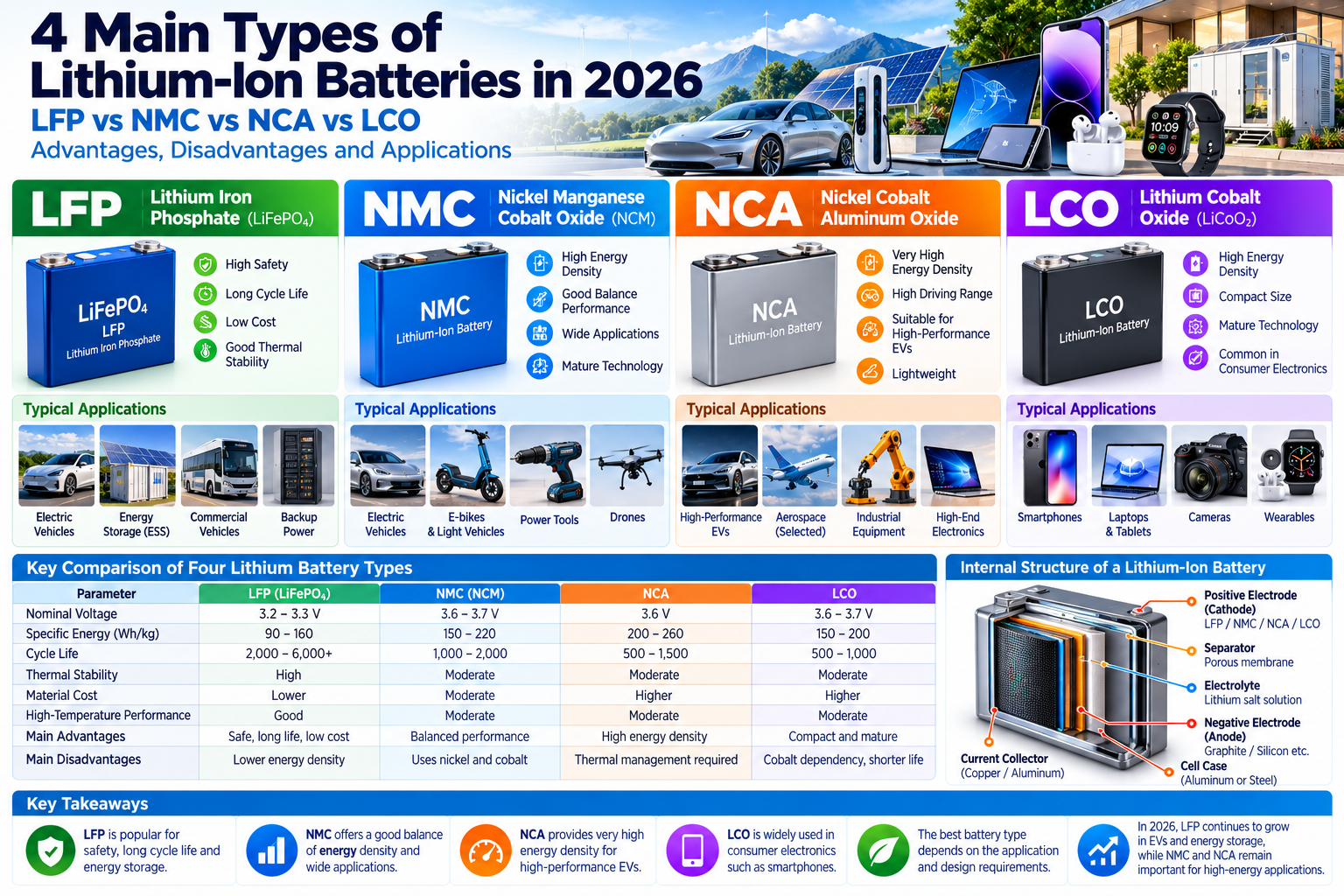
An LFP battery is a rechargeable lithium-ion battery that uses lithium iron phosphate (LiFePO4) as its cathode material.
During charging and discharging, lithium ions move between the battery's electrodes through an electrolyte while electrons travel through the external electrical circuit.
LFP batteries typically have a nominal cell voltage of approximately 3.2–3.3V, depending on the manufacturer's specification.
The chemistry is known for its relatively stable phosphate-based cathode structure, long cycle life and absence of nickel and cobalt in the cathode.
Main Advantages of LFP Batteries
- Long cycle life under suitable operating conditions.
- Strong cathode thermal stability.
- Lower dependence on expensive nickel and cobalt materials.
- Attractive economics for high-cycle applications.
- Suitable for stationary energy storage and many electric vehicle designs.
- Relatively stable discharge voltage over a broad state-of-charge range.
Main Disadvantages of LFP Batteries
- Lower energy density than many modern NMC cells.
- Potentially greater battery weight for the same stored energy.
- Reduced charging capability at low temperatures without suitable thermal management.
- More difficult voltage-based state-of-charge estimation because of the relatively flat voltage curve.
LFP batteries are commonly used in electric vehicles, electric buses, solar energy storage, backup power systems and selected industrial applications.
2. What Is an NMC Battery?
An NMC battery uses a lithium nickel manganese cobalt oxide cathode.
Nickel, manganese and cobalt contribute different characteristics to the cathode material, allowing manufacturers to develop formulations that balance energy density, stability, cost and power performance.
Common NMC designations include NMC111, NMC532, NMC622 and NMC811. These labels describe the approximate relative proportions of nickel, manganese and cobalt in the transition-metal composition.
NMC cells typically have nominal voltages around 3.6–3.7V, although exact values depend on the specific cell design.
Main Advantages of NMC Batteries
- Higher specific energy than conventional LFP designs.
- Potentially smaller and lighter battery packs for equivalent energy capacity.
- Flexible cathode formulations for different performance requirements.
- Established applications in electric vehicles and portable equipment.
- Useful energy-to-weight characteristics for mobility applications.
Main Disadvantages of NMC Batteries
- Nickel and cobalt contribute to raw-material cost and supply-chain exposure.
- Generally lower cathode thermal stability than LFP.
- Potentially faster degradation under certain high-temperature or high-state-of-charge conditions.
- Requires appropriate monitoring, charging control and thermal management.
NMC remains important for electric vehicles, e-bikes, portable industrial equipment and other systems where high energy density provides a meaningful advantage.
3. LFP vs NMC Battery Comparison Chart
The following table summarizes important differences between the two chemistries.
| Comparison Factor | LFP Battery | NMC Battery |
|---|---|---|
| Cathode Chemistry | Lithium iron phosphate | Lithium nickel manganese cobalt oxide |
| Nominal Cell Voltage | Approximately 3.2–3.3V | Approximately 3.6–3.7V |
| Illustrative Cell Specific Energy | 90–160 Wh/kg | 150–260 Wh/kg |
| Energy Density | Generally lower | Generally higher |
| Cycle Life | Generally longer | Highly design-dependent; often shorter |
| Cathode Thermal Stability | Generally higher | Generally lower |
| Nickel Content in Cathode | None | Present |
| Cobalt Content in Cathode | None | Present |
| Typical Cost Position | Generally lower | Generally higher |
| Cold-Weather Performance | Often more limited | Often advantageous |
| Typical EV Applications | Mass-market EVs, buses, commercial vehicles | Range-focused EVs and space-constrained platforms |
| Stationary Storage | Widely preferred | Used in selected applications |
Technical clarification: The specific-energy figures are broad historical reference ranges, not fixed specifications or maximum capabilities of all cells available in 2026. Advanced commercial cells can exceed these illustrative values. Battery performance varies by cathode formulation, cell format, manufacturing process and operating conditions.
For a reliable comparison, engineers should evaluate actual cell datasheets rather than assume every LFP or NMC battery has identical characteristics.
4. LFP vs NMC Energy Density: Which Battery Stores More Energy?
Energy density describes how much energy a battery stores relative to its mass or volume.
Gravimetric energy density is commonly expressed in watt-hours per kilogram (Wh/kg), while volumetric energy density is expressed in watt-hours per liter (Wh/L).
NMC batteries generally provide higher energy density than LFP batteries because of differences in cathode chemistry and operating voltage.
For an electric vehicle manufacturer, higher energy density can reduce the weight or physical size required to store a particular amount of electrical energy.
Example: A 60 kWh Battery Pack
Consider two hypothetical battery packs, each storing 60 kWh of nominal energy.
If an LFP pack achieves 140 Wh/kg at the pack level, its approximate mass would be:
60,000 Wh ÷ 140 Wh/kg = 429 kg
If an NMC pack achieves 170 Wh/kg at the pack level, its approximate mass would be:
60,000 Wh ÷ 170 Wh/kg = 353 kg
In this illustrative example, the NMC pack would be approximately 76 kg lighter.
These assumed values are for demonstrating the calculation and do not represent a verified comparison between specific commercial battery packs.
Actual pack mass also includes cooling systems, electrical interconnections, structural materials, protective enclosures and control electronics.
Can LFP Technology Reduce the Energy Density Gap?
Yes. Improvements in cell packaging, electrode design and pack architecture can reduce some of LFP's system-level disadvantages.
Cell-to-pack and cell-to-chassis designs can improve packaging efficiency by reducing some intermediate structural components.
However, a better pack architecture does not eliminate the underlying differences between the cathode materials.
Verdict: NMC generally has the advantage when energy density and battery weight are primary requirements.
5. LFP vs NMC Safety: Which Battery Has Better Thermal Stability?
Battery safety is one of the most important considerations for electric vehicles, household storage and industrial energy systems.
LFP batteries generally have better cathode thermal stability than NMC batteries.
The phosphate-based cathode structure is more resistant to oxygen release under certain abusive conditions, which can reduce the severity of some thermal runaway mechanisms.
NMC batteries can also be engineered for safe commercial operation, but they typically require careful attention to temperature monitoring, cell protection and thermal propagation management.
What Is Thermal Runaway?
Thermal runaway occurs when internal battery reactions generate heat faster than it can be dissipated, potentially causing a rapid increase in temperature.
Possible initiating conditions include internal short circuits, severe overcharging, mechanical damage, manufacturing defects and excessive heat.
Thermal runaway can produce hot gases, fire and other hazardous conditions.
Does LFP Mean Fireproof?
No. LFP batteries are not fireproof.
Although the cathode is comparatively stable, conventional LFP cells still contain combustible electrolyte materials and can experience hazardous failure under severe abuse.
Battery safety depends on the complete cell and pack design, including protective electronics, cooling, enclosure construction, fault detection and installation conditions.
Verdict: LFP generally offers an intrinsic cathode thermal-stability advantage, but both chemistries require robust system-level safety engineering.
6. LFP vs NMC Cycle Life: Which Battery Lasts Longer?
Battery cycle life describes how many charge-discharge cycles a battery can complete before its capacity falls to a specified threshold.
One full equivalent cycle represents energy throughput equivalent to a complete discharge and recharge of the battery's nominal capacity.
Cycle life depends on factors such as:
- Depth of discharge.
- Operating temperature.
- Charging current.
- Discharging current.
- Maximum charging voltage.
- Time spent at high state of charge.
- Cell design and manufacturing quality.
LFP batteries are generally associated with longer cycle life than NMC batteries under comparable operating conditions.
However, published cycle-life numbers should never be compared without checking the test conditions and end-of-life criteria.
Why Cycle Life Matters for Solar Storage
A stationary battery that cycles frequently may accumulate thousands of equivalent cycles over its operating life.
Long cycle life can reduce replacement frequency and improve lifetime economics.
For example, a battery system completing one full equivalent cycle per day would accumulate approximately 3,650 cycles over ten years.
This arithmetic example does not predict that a particular battery will survive ten years or retain a specified capacity. Calendar aging and environmental conditions also influence service life.
Calendar Life vs Cycle Life
Calendar life refers to battery degradation over time, including periods when the battery is not actively cycling.
A battery may experience capacity loss from both calendar aging and cycling.
For vehicles driven relatively infrequently, calendar aging may be particularly relevant. For high-utilization storage systems, cycle-related degradation can become more important.
Verdict: LFP usually offers a cycle-life advantage, especially in applications involving frequent charging and discharging.
7. LFP vs NMC Charging Speed and Cold-Weather Performance
Charging speed is frequently misunderstood in comparisons between lithium battery chemistries.
Neither LFP nor NMC is automatically faster charging in every application.
Actual charging performance depends on electrode design, internal resistance, cell temperature, state of charge, charging infrastructure and the battery management system.
Fast Charging
Modern LFP and NMC cells can both be designed for high charging rates.
However, the ability to accept a high charging current is limited by cell-specific operating conditions and thermal behavior.
A manufacturer's advertised peak charging rate should not be confused with the average charging rate across a complete charging session.
Charging often slows as the battery approaches a high state of charge to manage voltage and degradation constraints.
Cold-Weather Charging
Low temperatures can reduce lithium-ion battery performance and increase the risk of lithium plating during charging.
LFP systems often face greater cold-weather performance challenges than comparable NMC systems, although the result depends on cell design and thermal management.
Battery heating systems can improve charging performance by bringing cells into an appropriate operating temperature range.
Charging a lithium-ion battery outside its approved temperature limits can damage the cell or create safety risks.
Charging to 100%
LFP systems may support more frequent full charging than many NMC systems, depending on manufacturer guidance.
Some electric vehicle manufacturers recommend periodic full charging of LFP packs to support state-of-charge calibration.
However, this is not a universal instruction. Charging behavior must follow the battery or vehicle manufacturer's recommendations.
Verdict: NMC often offers advantages in cold climates, while fast-charging performance must be evaluated at the individual cell and pack level.
8. LFP vs NMC Cost: Which Battery Is More Economical?
Battery cost is a major factor influencing the adoption of different chemistries.
LFP batteries benefit from cathode materials that do not require nickel or cobalt.
NMC cathodes use nickel, manganese and cobalt, making their production economics more sensitive to certain critical mineral markets.
The International Energy Agency reports that average LFP battery pack prices in 2025 were more than 40% lower per kilowatt-hour than NMC alternatives across the applications included in its analysis.
This comparison is a market average, not a guaranteed price difference for equivalent automotive battery packs. Differences in application mix, pack design, geography and purchasing arrangements influence the result.
Initial Purchase Cost
LFP often offers a lower upfront cost per unit of stored energy, particularly in markets with mature LFP manufacturing supply chains.
Lifetime Cost
For applications involving frequent cycling, lifetime economics can be more informative than initial purchase price.
Engineers may evaluate the cost per delivered kilowatt-hour over the battery's useful life.
A simplified calculation is:
Lifetime Energy Throughput = Usable Battery Capacity × Equivalent Full Cycles
Cost per Delivered kWh = Total Relevant Lifetime Cost ÷ Lifetime Energy Delivered
A complete economic model should also consider degradation, round-trip efficiency, maintenance, replacement costs, discount rates and the expected duty cycle.
Example of Lifetime Economics
Consider two hypothetical 10 kWh battery systems:
- System A costs $3,000 and delivers 4,000 equivalent full cycles.
- System B costs $3,500 and delivers 2,000 equivalent full cycles.
Ignoring degradation and efficiency losses, System A would deliver approximately 40,000 kWh over its assumed cycling life, while System B would deliver 20,000 kWh.
Under these simplified assumptions, the purchase cost per delivered kilowatt-hour would be approximately $0.075 for System A and $0.175 for System B.
These are illustrative financial assumptions, not market quotations or guaranteed performance figures for LFP or NMC products.
Verdict: LFP often offers an advantage in upfront battery cost and lifetime economics for applications prioritizing frequent cycling.
9. LFP vs NMC for Electric Vehicles: Which Chemistry Is Better?
Electric vehicle battery selection involves trade-offs between cost, range, charging performance, weight, safety and vehicle architecture.
There is no single battery chemistry that provides the best outcome for every vehicle category.
LFP for Mass-Market Electric Vehicles
LFP is attractive for vehicles where affordability, durability and everyday usability are important.
Its lower material cost can help manufacturers offer competitive vehicle pricing.
Long cycle life may also benefit commercial vehicles and other high-utilization applications.
NMC for Range-Focused Electric Vehicles
NMC can be attractive where a vehicle requires substantial battery energy within a constrained weight or volume envelope.
Its higher energy density can support vehicle design flexibility and potentially longer range, although real-world driving range also depends on aerodynamics, drivetrain efficiency, vehicle mass and environmental conditions.
Commercial Vehicles and Electric Buses
Commercial vehicles often prioritize durability, predictable operating schedules and total cost of ownership.
LFP is widely used in electric buses and other commercial applications where its cycle-life and cost characteristics can be beneficial.
Cold-Climate Vehicles
NMC can offer advantages in low-temperature operation, but thermal management and vehicle-level engineering remain decisive.
A well-designed LFP battery pack with suitable preheating may perform better in practical use than a poorly optimized alternative.
EV Selection Summary: LFP is often a strong choice for affordable and high-utilization vehicles, while NMC remains attractive for vehicles prioritizing high energy density.
10. LFP vs NMC for Solar Energy Storage and Home Batteries
Stationary energy storage systems have different requirements from electric vehicles.
A home battery does not usually need to minimize weight as aggressively as a vehicle battery.
Instead, key priorities often include:
- Long service life.
- High cycle durability.
- Safe installation and operation.
- Competitive lifetime cost.
- Reliable battery management.
- Compatibility with solar inverters and energy management systems.
LFP is widely preferred for many stationary storage applications because it offers favorable cycle-life, thermal-stability and cost characteristics.
According to the IEA's 2026 analysis, LFP represented more than 90% of global stationary battery storage installations in 2025.
Residential Solar Batteries
LFP is often selected for residential energy storage because the system may charge during the day and discharge in the evening, creating repeated cycling.
Long cycle life and suitable protection systems can improve the economics of such applications.
Commercial and Industrial Storage
Commercial systems may use batteries for peak-demand management, backup power and renewable energy integration.
For these applications, the total cost of ownership and operating profile often matter more than maximum specific energy.
When Could NMC Be Suitable?
NMC may still be considered where installation space or weight is unusually constrained, or where a particular battery system offers application-specific advantages.
Storage Selection Summary: LFP is generally the more common and often more economical choice for modern stationary energy storage, but system certification and engineering remain essential.
11. Battery Management Systems: The Electronic Components Behind LFP and NMC
Battery chemistry is only one part of a reliable rechargeable energy system.
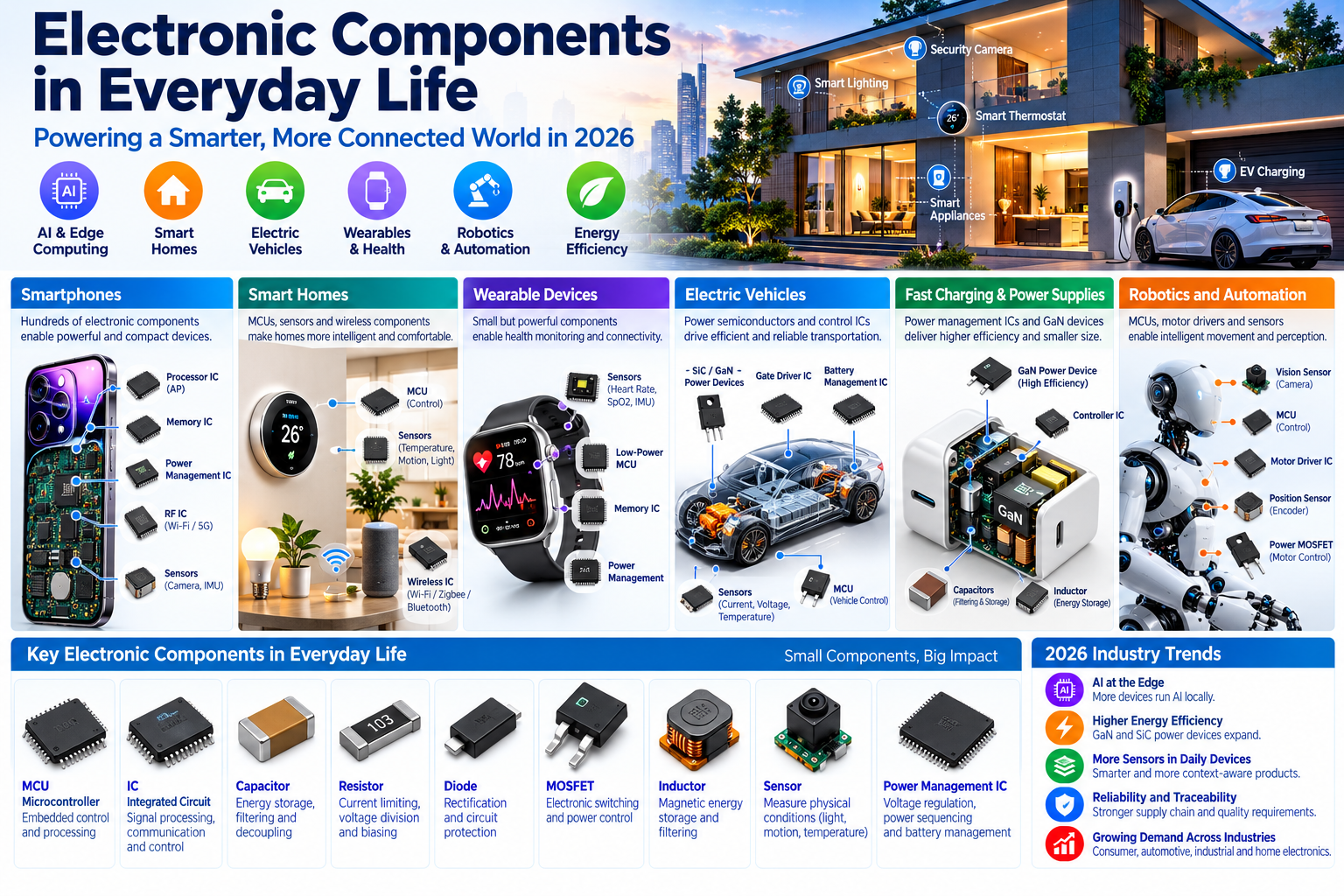
Modern battery packs also require monitoring, protection, control and communication electronics.
A battery management system (BMS) helps keep battery cells within their permitted operating limits.
Battery Monitoring ICs
Battery monitoring integrated circuits measure cell voltages and may support temperature sensing, diagnostic functions and balancing control.
These measurements help the system identify abnormal conditions and estimate battery state.
Microcontrollers
Microcontrollers process measurement data, execute protection algorithms, coordinate charging and communicate with external equipment.
Embedded software must be developed and validated for the specific battery architecture.
Power MOSFETs and Gate Drivers
Power MOSFETs are used in selected battery protection and switching circuits.
Gate-driver ICs help control switching devices where the circuit architecture requires dedicated drive capability.
High-voltage battery systems may also use contactors, precharge circuits and other protective devices.
Current-Sense Resistors
Low-resistance shunt resistors can support accurate current measurement.
Selection factors include resistance tolerance, temperature coefficient, power dissipation and measurement accuracy.
Capacitors and TVS Diodes
Capacitors provide filtering and decoupling for BMS power supplies and measurement circuits.
Transient voltage suppressor diodes can protect appropriate interfaces against specified transient electrical events.
Temperature Sensors
Temperature sensors provide information for thermal protection, charging control and battery performance management.
Sensor placement and measurement accuracy are important because temperature can vary across a battery pack.
Why LFP and NMC Need Different BMS Settings
LFP and NMC cells have different nominal voltages, charging limits and voltage-versus-state-of-charge characteristics.
Therefore, a BMS designed or configured for one chemistry must not be assumed compatible with the other.
The complete system must use manufacturer-approved voltage thresholds, temperature limits, balancing strategies and fault responses.
| Electronic Component | Primary Function | Battery Application |
|---|---|---|
| Battery Monitoring IC | Cell voltage monitoring | LFP and NMC BMS |
| Microcontroller | Battery control and diagnostics | EV and storage systems |
| Power MOSFET | Electrical switching | Protection and power paths |
| Gate Driver | Power transistor control | Battery switching circuits |
| Current-Sense Resistor | Current measurement | Charge/discharge monitoring |
| MLCC Capacitor | Filtering and decoupling | BMS control boards |
| TVS Diode | Transient suppression | Power and communication interfaces |
| Temperature Sensor | Thermal measurement | Battery safety monitoring |
| Isolation IC | Signal isolation | High-voltage battery systems |
For electronic component manufacturers and distributors, the growth of battery applications creates opportunities across analog ICs, embedded controllers, power semiconductors and passive components.
12. LFP vs NMC Market Trends in 2026
Battery market trends in 2026 show that cost, manufacturing capacity, critical mineral supply and application requirements are shaping chemistry adoption.
Trend One: LFP Has Become the Leading Global EV Chemistry
The IEA reports that LFP accounted for more than 55% of EV batteries deployed worldwide in 2025.
This reflects increasing adoption in China and emerging markets, along with growing interest in other regions.
Trend Two: Battery Prices Remain a Major Competitive Factor
Lower-cost cathode materials have helped LFP compete strongly against nickel-based chemistries.
However, battery pricing is affected by raw-material markets, production scale, supply agreements and regional trade conditions.
Current price advantages should not be treated as permanent or uniform across every market.
Trend Three: NMC Remains Relevant for High-Energy Applications
Although LFP has expanded, NMC continues to offer advantages for vehicle platforms where higher energy density is valuable.
Automakers must balance battery chemistry with vehicle architecture, cost targets and expected operating conditions.
Trend Four: Regional Supply Chains Are Becoming More Important
Battery manufacturing and cathode-material production remain geographically concentrated.
Regional sourcing requirements, tariffs, manufacturing investments and supply-chain diversification can influence which battery chemistry is commercially attractive.
Trend Five: New Technologies May Change the Competitive Landscape
Emerging technologies include lithium manganese iron phosphate (LMFP), sodium-ion batteries, silicon-rich anodes and developing solid-state battery architectures.
These technologies may complement existing lithium-ion chemistries rather than replace all of them.
Commercial adoption will depend on manufacturing maturity, performance, cost, safety and availability.
13. How to Choose Between LFP and NMC Batteries
Battery selection should begin with the intended application rather than the chemistry name alone.
| Design Priority | Often Preferred | Reason |
|---|---|---|
| Lower Initial Cost | LFP | Generally lower-cost cathode materials |
| High Energy Density | NMC | Higher energy per unit mass or volume |
| Frequent Deep Cycling | LFP | Generally favorable cycle durability |
| Stationary Solar Storage | LFP | Lifetime economics and thermal stability |
| Weight-Constrained EV Design | NMC | Higher specific energy |
| Cost-Sensitive Electric Vehicle | LFP | Competitive cost and durability |
| Cold-Climate Operation | Often NMC | Generally better low-temperature characteristics |
| High Thermal Stability | LFP | More stable phosphate cathode |
Five Questions to Ask Before Selecting a Battery
- How much usable energy is required? Determine the actual energy capacity and operating voltage requirements.
- How important are weight and size? Higher energy density may justify a more expensive chemistry.
- How frequently will the battery cycle? Frequent cycling makes long-term degradation particularly important.
- What temperatures will the system experience? Evaluate both charging and discharging conditions.
- What are the safety and certification requirements? Consider cell qualification, BMS design, enclosure protection and applicable standards.
The final decision should be supported by manufacturer datasheets, application-specific testing and a complete lifetime cost assessment.
14. Frequently Asked Questions About LFP vs NMC Batteries
Is LFP better than NMC?
LFP is often better for applications prioritizing cost, cycle life and thermal stability. NMC is often better where higher energy density and reduced battery weight are important.
Which battery lasts longer, LFP or NMC?
LFP generally offers longer cycle life under comparable conditions, although actual lifespan depends on cell design, charging behavior, temperature and usage patterns.
Is LFP safer than NMC?
LFP generally has better intrinsic cathode thermal stability. However, neither chemistry is inherently risk-free, and both require appropriate battery management and protection.
Why is NMC more expensive than LFP?
NMC cathodes contain nickel and cobalt, while LFP cathodes use iron and phosphate. Raw-material prices, manufacturing costs and market conditions influence the final price difference.
Which battery is better for solar storage?
LFP is commonly preferred for stationary energy storage because of its cycle life, thermal characteristics and cost advantages.
Which battery is better for electric vehicles?
LFP is attractive for affordable, durable EVs, while NMC remains useful for designs that prioritize energy density and weight reduction.
Can LFP batteries charge faster than NMC batteries?
Some LFP cells support very high charging rates, and some NMC cells do as well. Charging speed depends on the specific cell, temperature, battery pack design and charging system.
Does NMC perform better in cold weather?
NMC generally offers advantages in low-temperature performance, although effective battery heating and control systems can significantly influence real-world results.
Can an NMC battery replace an LFP battery directly?
No direct replacement should be assumed. Their voltage characteristics, charging limits and BMS requirements differ. Any replacement requires engineering verification and appropriate system modifications.
What is the difference between NMC and NCM?
NMC and NCM refer to the same general family of lithium nickel manganese cobalt oxide cathode materials. The letter order differs, but the terms are commonly used interchangeably.
15. Conclusion: LFP vs NMC - Two Important Batteries for Different Needs
The competition between LFP and NMC reflects the diverse requirements of modern battery-powered products.
LFP batteries offer compelling advantages in cycle life, cathode thermal stability and material economics. These characteristics have supported their rapid expansion in electric vehicles and stationary energy storage.
NMC batteries continue to offer higher energy density, making them important for applications where battery mass, volume and driving range are major design priorities.
Neither chemistry should be selected solely because of its popularity.
Engineers and procurement teams should compare the actual cell specifications, expected duty cycle, charging environment, system safety requirements and total lifetime cost.
For electronic component suppliers, both technologies create ongoing demand for battery monitoring ICs, microcontrollers, MOSFETs, gate drivers, sensors, resistors, capacitors and protection devices.
In 2026, LFP is increasingly important for affordable and durable energy storage, while NMC remains a valuable choice for high-energy applications. The best battery is the one that meets the complete technical and commercial requirements of the system.
Technical References and Industry Sources
- International Energy Agency - Global EV Outlook 2026: Electric Vehicle Batteries
- International Energy Agency - Global EV Outlook 2025: Battery Chemistry and Cost
- Natural Resources Canada - Benchmarking the Canadian Battery Ecosystem
- Scientific Review - Comparative Study of LFP and NMC Battery Technologies
- Battery Council International - Battery Chemistry Resources
Editorial Disclaimer: This article provides general battery engineering and market information. Battery specifications, charging limits, cycle life and safety characteristics vary by manufacturer and cell design. All battery systems must be engineered and operated according to applicable standards and manufacturer instructions. Market data is attributed to the cited industry sources and should not be interpreted as a guarantee of future market performance.