

Four Major Types of Lithium-Ion Batteries in 2026: Advantages, Disadvantages, Applications and Market Trends
Industry Overview: Lithium-ion batteries are essential to electric vehicles, smartphones, renewable energy storage, portable electronics, and industrial equipment. However, not all lithium batteries deliver the same performance. This guide compares four important lithium-ion battery chemistries-LFP, NMC, NCA, and LCO-explaining their strengths, limitations, applications, and relevance to the battery market in 2026.
Why Lithium Battery Chemistry Matters in 2026
The global transition toward electric transportation, renewable energy, intelligent consumer electronics, and electrified industrial equipment has increased the importance of rechargeable lithium-ion batteries.
From smartphones and electric bicycles to electric vehicles and large battery energy storage systems, lithium-ion technology has become a foundation of modern electrical products.
However, choosing the right battery is not simply a matter of comparing capacity or price.
Different lithium-ion battery chemistries offer different combinations of energy density, cycle life, thermal stability, power capability, charging performance, material cost, and operating voltage.
For example, a smartphone manufacturer may prioritize high energy density and compact dimensions. A solar energy storage system may place greater importance on cycle life, safety, and cost per delivered kilowatt-hour. An electric vehicle manufacturer must balance driving range, charging performance, thermal management, and manufacturing economics.
Four important battery chemistries illustrate these engineering trade-offs:
- LFP: Lithium Iron Phosphate (LiFePO4)
- NMC/NCM: Lithium Nickel Manganese Cobalt Oxide
- NCA: Lithium Nickel Cobalt Aluminum Oxide
- LCO: Lithium Cobalt Oxide (LiCoO2)
These categories refer primarily to cathode chemistry. Commercial lithium-ion cells also contain anodes, electrolytes, separators, current collectors, and protective structures that influence their overall performance.
According to the International Energy Agency's Global EV Outlook 2026, LFP batteries accounted for more than 55% of global electric vehicle battery deployment in 2025. This reflects the growing importance of cost-effective battery technologies, particularly in electric vehicles and stationary energy storage.
Understanding the different types of lithium batteries is therefore essential for engineers, battery manufacturers, system designers, and electronic component procurement teams.
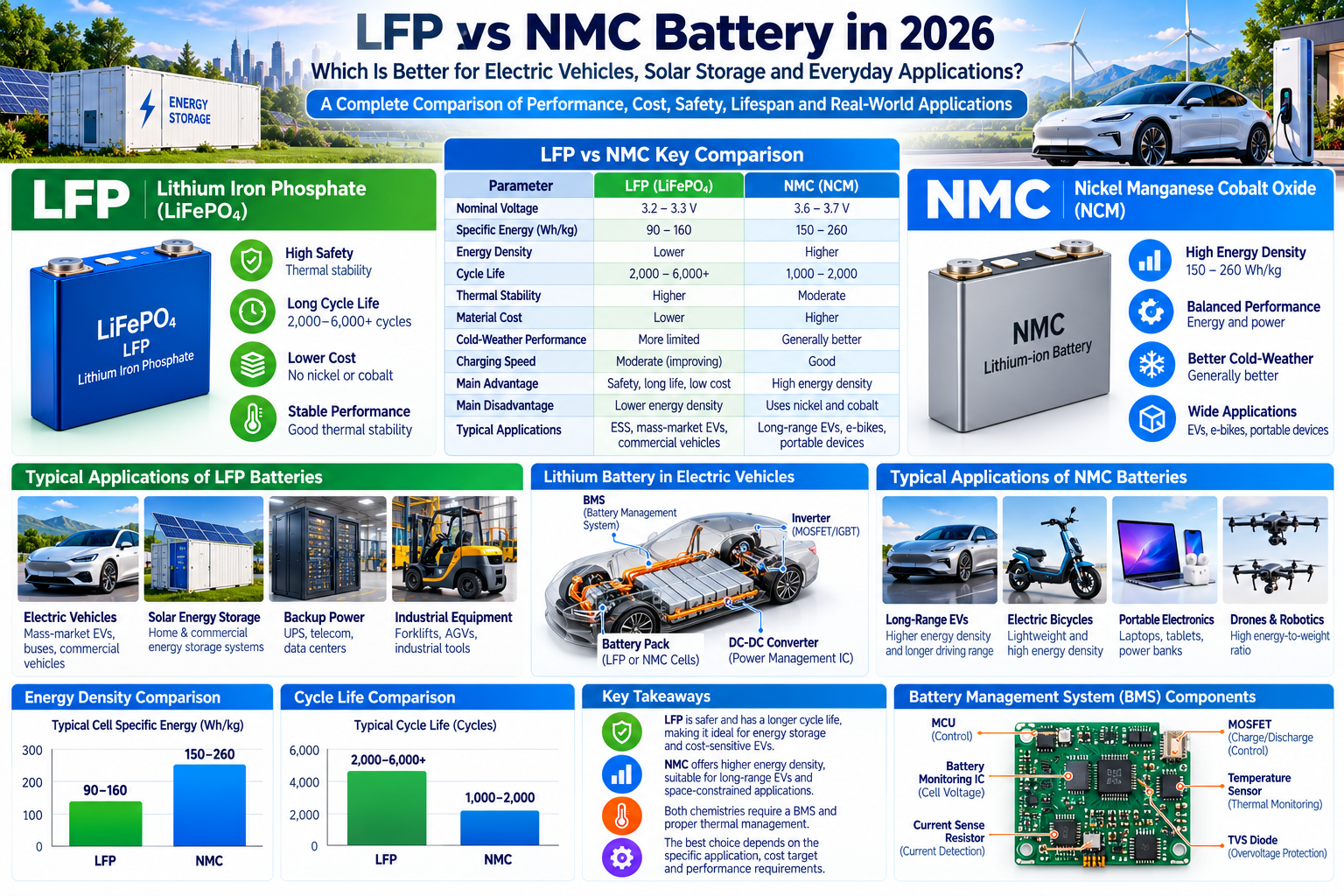
1. Lithium Battery Comparison Chart: LFP vs NMC vs NCA vs LCO
The following lithium battery comparison chart summarizes typical characteristics of the four chemistries.
| Parameter | LFP | NMC | NCA | LCO |
|---|---|---|---|---|
| Full Name | Lithium Iron Phosphate | Lithium Nickel Manganese Cobalt Oxide | Lithium Nickel Cobalt Aluminum Oxide | Lithium Cobalt Oxide |
| Nominal Cell Voltage | Approximately 3.2–3.3V | Approximately 3.6–3.7V | Approximately 3.6V | Approximately 3.6–3.7V |
| Illustrative Specific Energy | 90–160 Wh/kg | 150–220 Wh/kg | 200–260 Wh/kg | 150–200 Wh/kg |
| Cycle Life | Generally long | Moderate to long | Design-dependent | Generally moderate |
| Thermal Stability | Relatively high | Requires careful management | Requires careful management | Requires careful management |
| Nickel or Cobalt in Cathode | Neither | Both | Both | Cobalt |
| Typical Applications | Energy storage, EVs, commercial vehicles | EVs, e-bikes, industrial equipment | Selected EVs, high-energy battery packs | Smartphones, cameras, portable electronics |
| Main Advantage | Long life and strong thermal stability | Balanced energy and power performance | High energy density | Compact, high-energy consumer cells |
| Main Limitation | Lower energy density | Nickel/cobalt dependence and thermal requirements | Thermal management and material cost | Cobalt dependence and cycle-life limitations |
Technical note: Energy-density ranges are illustrative cell-level values drawn from published battery-chemistry references. They are not guaranteed specifications or uniform 2026 market averages. Modern cells can fall outside these ranges. Cycle life also depends strongly on temperature, depth of discharge, charge rate, and the manufacturer's end-of-life definition.
The table highlights a central principle: there is no universally best lithium-ion battery chemistry. The preferred technology depends on the intended application.
2. Lithium Iron Phosphate Battery (LFP): Advantages, Disadvantages and Applications
Lithium iron phosphate batteries, commonly called LFP or LiFePO4 batteries, use lithium iron phosphate as the cathode material.
LFP technology has become especially important in electric vehicles, solar energy storage, commercial transportation, and backup power systems.
Advantages of LFP Batteries
- Long cycle life: LFP cells are often designed for thousands of charge-discharge cycles, making them attractive for frequently used energy storage systems.
- Strong thermal stability: The phosphate-based cathode structure generally provides better resistance to thermal instability than many nickel-rich cathode chemistries.
- Lower cathode material cost: LFP does not require nickel or cobalt in its cathode, reducing exposure to those raw-material costs.
- Suitable for stationary storage: Where weight and volume are less restrictive, LFP offers a compelling combination of longevity and economics.
- Flat discharge voltage: Its relatively stable voltage profile can be beneficial for certain power applications.
Disadvantages of LFP Batteries
- Lower energy density than many NMC and NCA designs.
- Potentially greater battery mass or volume for a given energy capacity.
- Reduced charging performance at low temperatures without appropriate thermal control.
- A relatively flat voltage curve that makes accurate state-of-charge estimation more challenging when relying only on voltage.
Where Are LFP Batteries Used?
Electric Vehicles: LFP is widely used in cost-sensitive passenger vehicles, commercial vehicles, and applications where durability and affordability are important.
Solar Energy Storage: Residential and commercial energy storage systems frequently use LFP because of its long cycle life and favorable thermal characteristics.
Backup Power: LFP battery systems are used in selected UPS installations, telecommunications equipment, and backup energy systems.
Recreational and Off-Grid Systems: Properly designed LFP batteries are popular in RVs, marine auxiliary power, and off-grid energy storage.
Industry Outlook: LFP is particularly well positioned where lifetime cost, cycle durability, and thermal stability matter more than maximum energy density.
3. Nickel Manganese Cobalt Battery (NMC): Advantages, Disadvantages and Applications
NMC batteries, also called NCM batteries, use a cathode containing nickel, manganese, and cobalt.
Different formulations adjust the relative amounts of these materials. Common industry designations include NMC111, NMC532, NMC622, and NMC811.
These variations are important because the performance of an NMC battery depends partly on its nickel content, material processing, and cell design.
Advantages of NMC Batteries
- High energy density: NMC cells can store substantial energy relative to their weight.
- Balanced performance: Appropriate designs offer useful combinations of energy capacity, power capability, and service life.
- Flexible formulations: Cathode compositions can be optimized for different performance targets.
- Broad application suitability: NMC technology supports transportation, portable equipment, and selected industrial applications.
Disadvantages of NMC Batteries
- Dependence on nickel and cobalt supply chains.
- More demanding thermal-management requirements than LFP in many applications.
- Potential performance degradation under sustained high temperatures or aggressive charging conditions.
- Battery costs that can be affected by raw-material pricing and cathode formulation.
Where Are NMC Batteries Used?
Electric Vehicles: NMC batteries are used in vehicles where energy density and driving range are important design priorities.
Electric Bicycles: Their energy-to-weight characteristics make NMC attractive for selected e-bike battery packs.
Portable Industrial Equipment: NMC can be suitable for equipment requiring meaningful energy capacity without excessive battery weight.
Medical and Specialized Devices: Certain rechargeable systems use NMC cells when their electrical characteristics match the application's safety and performance requirements.
Industry Outlook: NMC remains important in applications that prioritize a balanced combination of energy density, power, and packaging efficiency.
4. Nickel Cobalt Aluminum Battery (NCA): Advantages, Disadvantages and Applications
NCA batteries use lithium nickel cobalt aluminum oxide cathode materials.
They are associated with high specific energy and have been used in selected electric vehicle battery platforms and specialized rechargeable applications.
NCA and NMC share several characteristics, but their cathode formulations and performance trade-offs are different.
Advantages of NCA Batteries
- High energy density: NCA can provide substantial energy storage relative to cell mass.
- Suitable for long-range applications: High specific energy is attractive when battery weight is an important design constraint.
- Good power capability in appropriate designs: NCA cells can support demanding applications when properly engineered.
- Established manufacturing experience: NCA has a history of commercial use in selected automotive and industrial battery systems.
Disadvantages of NCA Batteries
- Requires robust thermal and electrical protection.
- Uses nickel and cobalt, exposing production costs to material markets.
- Cycle life depends significantly on cell design and operating conditions.
- May be less attractive than LFP for applications where low cost and very long cycling life dominate.
Where Are NCA Batteries Used?
Electric Vehicles: NCA has been used in selected high-energy electric vehicle battery packs.
Industrial Battery Systems: NCA may be selected for specialized systems requiring high energy storage in a limited weight envelope.
Portable High-Energy Equipment: Some battery products can benefit from the chemistry's specific-energy characteristics, subject to suitable cell availability and protection design.
Industry Outlook: NCA remains a relevant technology for applications where high energy density justifies additional material and thermal-management considerations.
5. Lithium Cobalt Oxide Battery (LCO): Advantages, Disadvantages and Applications
Lithium cobalt oxide batteries, or LCO batteries, are among the earliest commercially successful lithium-ion battery technologies.
LCO has a long history in consumer electronics, particularly products where compact dimensions and energy storage are important.
Advantages of LCO Batteries
- High specific energy: Suitable LCO cells can deliver useful capacity in compact consumer-electronics designs.
- Established technology: The chemistry has extensive manufacturing and application history.
- Suitable for portable devices: LCO is associated with battery-powered products where small size is valuable.
- Well-understood charging behavior: Mature cell designs can be integrated with appropriately configured charging and protection electronics.
Disadvantages of LCO Batteries
- High dependence on cobalt as a cathode material.
- Less attractive for applications requiring extremely long cycle life.
- Thermal and electrical safety concerns if improperly charged, damaged, or operated.
- Not generally the preferred choice for large, cost-sensitive stationary energy storage systems.
Where Are LCO Batteries Used?
Smartphones: LCO and related high-energy lithium-ion designs have been widely used in mobile electronics.
Digital Cameras: Rechargeable camera batteries are a traditional application for high-energy lithium-ion cells.
Tablets and Portable Electronics: Compact rechargeable batteries help meet size and weight requirements.
Specialized Consumer Devices: Certain portable products may use LCO-based cells where their performance characteristics are suitable.
Industry Outlook: LCO remains historically and technically important in consumer electronics, although modern portable-device batteries may use blended or alternative cathode chemistries.
6. Which Lithium Battery Is Best for Different Applications?
The best battery chemistry depends on the engineering priorities of the product.
| Application | Commonly Suitable Chemistry | Main Selection Priority |
|---|---|---|
| Solar Energy Storage | LFP | Cycle life, cost, thermal stability |
| Residential Backup Battery | LFP | Long service life and reliability |
| Cost-Sensitive Electric Vehicle | LFP | Battery cost and durability |
| Long-Range Electric Vehicle | NMC or NCA | Energy density and battery weight |
| Electric Bicycle | NMC or other suitable Li-ion designs | Weight, range, power capability |
| Smartphone | LCO or other high-energy Li-ion chemistry | Compact size and energy density |
| Portable Industrial Equipment | NMC, LFP, or application-specific chemistry | Power, runtime, life, and safety |
| Commercial Energy Storage | LFP | Lifetime economics and operational reliability |
These are application tendencies rather than universal rules. A battery chemistry should never be selected without reviewing the actual cell specifications and complete system requirements.
Best Lithium Battery for Solar Storage
LFP is often an attractive choice because stationary storage typically prioritizes long cycle life, thermal stability, and cost over minimum battery weight.
Best Battery Chemistry for Electric Vehicles
LFP is widely used where affordability and durability are important. NMC and NCA remain relevant where higher energy density can help meet vehicle range or packaging targets.
Best Lithium Battery for Portable Electronics
High-energy lithium-ion chemistries, including LCO-based and other modern formulations, are commonly considered for compact portable devices.
7. Lithium Battery Safety: Why Chemistry Is Only Part of the Answer
Battery chemistry affects thermal stability, but overall safety depends on much more than the cathode material.
Cell quality, manufacturing consistency, charging conditions, mechanical protection, cooling, electrical isolation, and system-level fault management all influence battery safety.
Although LFP generally offers favorable thermal stability, no lithium-ion battery chemistry is completely free from fire or thermal runaway risks.
Battery Management Systems
A battery management system (BMS) monitors and manages operating conditions within a rechargeable battery pack.
Depending on the application, a BMS may provide:
- Individual cell voltage monitoring.
- Charge and discharge current measurement.
- Temperature monitoring.
- Overvoltage and undervoltage protection.
- Overcurrent and short-circuit protection.
- Cell balancing.
- State-of-charge and state-of-health estimation.
- Communication with chargers and host controllers.
The BMS must be configured for the actual battery chemistry. For example, LFP and NMC cells have different nominal voltages and charging limits.
Using a charging profile intended for one chemistry with an incompatible battery can create serious safety hazards.
Battery system designers must follow the cell manufacturer's requirements and applicable safety standards.
8. Lithium Battery Market Trends in 2026
The lithium-ion battery industry is changing as manufacturers respond to electric vehicle demand, stationary energy storage growth, raw-material prices, and new technology requirements.
Trend One: LFP Continues Expanding in Electric Vehicles
The International Energy Agency reports that LFP accounted for more than 55% of global electric vehicle battery deployment in 2025.
Its growing adoption reflects the importance of lower-cost cathode materials and the willingness of many vehicle manufacturers to accept lower energy density in exchange for favorable economics.
Trend Two: Stationary Energy Storage Is Becoming More Important
Grid-connected storage, renewable energy integration, and backup power applications are supporting demand for rechargeable batteries.
Because stationary systems are generally less constrained by battery weight, long-life chemistries such as LFP are especially competitive.
Trend Three: Nickel-Rich Batteries Remain Relevant
High-energy NMC and NCA technologies remain important for applications that place substantial value on energy density.
Manufacturers continue evaluating the trade-offs between cathode composition, safety, durability, and production cost.
Trend Four: Raw-Material Prices Influence Battery Economics
Lithium, nickel, and cobalt prices can affect battery production costs.
According to the IEA's 2026 assessment, changes in lithium and cobalt markets have influenced battery-industry economics, while LFP's lack of nickel and cobalt in its cathode remains an important structural advantage.
Trend Five: Battery Innovation Is Expanding Beyond These Four Chemistries
Emerging and developing technologies include lithium manganese iron phosphate (LMFP), sodium-ion batteries, silicon-rich anodes, and solid-state battery architectures.
These technologies may address different combinations of cost, safety, energy density, and charging performance.
However, commercialization maturity varies considerably, and future adoption cannot be predicted from laboratory performance alone.
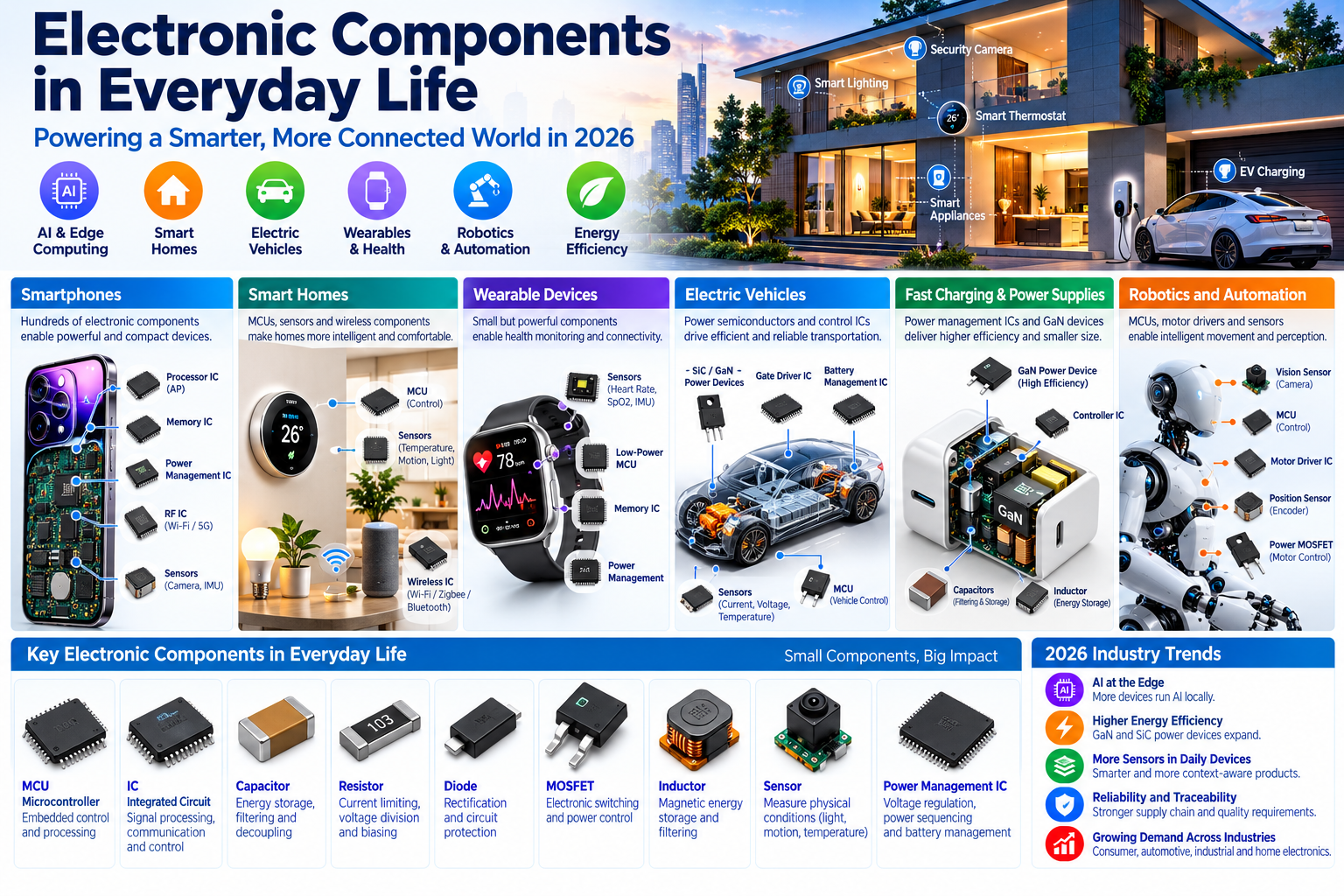
9. Electronic Components Used in Lithium Battery Systems
Modern rechargeable battery systems depend on electronic components for monitoring, control, charging, protection, and communication.
For electronic component manufacturers and distributors, battery applications represent opportunities extending beyond the battery cells themselves.
| Electronic Component | Function in Battery Systems | Typical Application |
|---|---|---|
| Battery Monitoring IC | Measures cell voltages and related parameters | Battery management systems |
| Microcontroller (MCU) | Processes battery data and controls system functions | EV and energy storage BMS |
| Power MOSFET | Controls electrical switching | Charge/discharge protection |
| Gate Driver IC | Drives power semiconductor gates | High-power switching circuits |
| Current-Sense Resistor | Supports current measurement | Battery current monitoring |
| Capacitor | Filtering and power-supply decoupling | BMS and charger circuits |
| TVS Diode | Suppresses specified transient overvoltages | Communication and power interfaces |
| Temperature Sensor | Measures battery or circuit temperature | Thermal monitoring |
| Isolation Component | Provides electrical isolation where required | High-voltage battery systems |
| DC-DC Converter | Converts voltage for electronic subsystems | Battery-powered control circuits |
For example, a battery monitoring IC may measure individual cell voltages, while a microcontroller evaluates operating conditions and communicates with the vehicle or energy storage controller.
Power MOSFETs, contactors, or other switching devices can support protective disconnection, depending on the system architecture.
Passive components such as resistors and capacitors also remain essential for measurement accuracy, filtering, voltage regulation, and circuit stability.
Component selection must account for operating voltage, electrical isolation, temperature range, functional safety, and the requirements of the final battery system.
10. Frequently Asked Questions About Lithium Battery Types
What are the four major types of lithium-ion batteries?
Four important lithium-ion battery chemistries are lithium iron phosphate (LFP), lithium nickel manganese cobalt oxide (NMC), lithium nickel cobalt aluminum oxide (NCA), and lithium cobalt oxide (LCO). Other significant chemistries include LMO, LTO, and LMFP.
Which lithium battery type is the safest?
LFP generally provides better cathode thermal stability than many nickel-rich lithium-ion chemistries. However, safety depends on the complete battery design, manufacturing quality, protection systems, and operating conditions.
Is LFP better than NMC?
LFP is often preferable for long-life, cost-sensitive applications. NMC is frequently attractive where higher energy density and lower battery weight are important. Neither is universally better.
What is the difference between NMC and NCA batteries?
NMC uses nickel, manganese, and cobalt in its cathode, while NCA uses nickel, cobalt, and aluminum. Both can provide high energy density, but their performance depends on formulation and cell design.
Which lithium battery lasts the longest?
Among the four chemistries compared here, LFP is widely associated with long cycle life. Other chemistries, such as lithium titanate (LTO), can offer even longer cycling performance in specialized applications.
Which lithium battery is best for solar energy storage?
LFP is commonly selected for stationary energy storage because of its cycle durability, thermal stability, and favorable cost characteristics.
Which battery chemistry is used in electric vehicles?
Electric vehicles use several battery chemistries, particularly LFP, NMC, and NCA. The selected chemistry depends on vehicle design, cost targets, energy density, and regional supply chains.
Are lithium-ion batteries and LiFePO4 batteries the same?
LiFePO4 batteries are a type of lithium-ion battery. Lithium-ion is the broader category, while LiFePO4 identifies a specific cathode chemistry.
Can LFP and NMC batteries use the same charger?
They should not be assumed compatible. Their cell voltage limits and charging requirements differ. A charger must support the exact battery configuration and manufacturer-specified charging profile.
11. Conclusion: Which Lithium Battery Chemistry Will Matter Most?
The lithium-ion battery market in 2026 is shaped by competing demands for affordability, energy density, safety, charging performance, and long-term durability.
LFP batteries are especially attractive for stationary energy storage and cost-sensitive electric vehicles because of their long cycle life, strong thermal stability, and nickel-free, cobalt-free cathode composition.
NMC batteries offer a useful balance of energy density and power performance, supporting electric vehicles, e-bikes, and industrial applications.
NCA batteries remain relevant where high energy density is an important system-level advantage.
LCO batteries continue to represent an important part of lithium-ion battery development, particularly in the history and design of compact consumer electronics.
For battery engineers, product manufacturers, and procurement specialists, the key is to evaluate the complete application rather than select a chemistry based on a single advertised specification.
Energy density, cycle life, safety, temperature behavior, charging requirements, supply-chain conditions, and total lifetime cost must all be considered.
As battery technology evolves, electronic components such as battery-monitoring ICs, microcontrollers, MOSFETs, sensors, resistors, and capacitors will remain essential for building efficient and reliable battery-powered systems.
The future of battery technology will not be defined by one universal chemistry, but by selecting the most appropriate chemistry and electronic control architecture for each application.
Technical References and Industry Sources
- International Energy Agency - Global EV Outlook 2026: Electric Vehicle Batteries
- International Energy Agency - Batteries and Secure Energy Transitions
- Battery University - Types of Lithium-ion Batteries
- Battery University - Summary Table of Lithium-Based Batteries
- International Telecommunication Union - Technical Publications on Lithium-Ion Battery Safety
Editorial Disclaimer: Battery performance figures are general engineering references rather than specifications for particular commercial cells. Battery design, charging, repair, and replacement must follow manufacturer requirements and applicable safety standards. Market information reflects sources available at the publication date.