

Why Ohm's Law Still Matters in Modern Electronics: Understanding Voltage, Current, and Resistance
November 9, 2026 | Electronics Engineering Insights
As electronic devices become smaller, more powerful, and increasingly energy-efficient, engineers continue to rely on fundamental electrical principles to develop reliable circuits. Among these principles, Ohm's Law remains one of the most important relationships in electrical and electronic engineering.
From microcontroller-based embedded systems and industrial automation equipment to power supplies, LED lighting, and electronic protection circuits, understanding the relationship between voltage, current, and resistance is essential for component selection and circuit design.
Although Ohm's Law was established in the nineteenth century, its practical importance continues in modern electronics. Engineers use it to calculate current flow, evaluate voltage drops, select resistors, and estimate electrical power dissipation.
This technical analysis explains the Ohm's Law formula, how to calculate voltage, current, and resistance, the difference between ohmic and non-ohmic devices, and how these concepts apply to real electronic circuits.
What Is Ohm's Law? Definition and Basic Theory
Ohm's Law describes the relationship between voltage, electric current, and electrical resistance in an ohmic conductor under conditions where its resistance remains constant.
The principle is named after German physicist Georg Simon Ohm, whose research helped establish the mathematical relationship between electrical potential difference and current.
The fundamental equation is:
V = I × R
Where:
- V = Voltage, measured in volts (V)
- I = Electric current, measured in amperes (A)
- R = Electrical resistance, measured in ohms (Ω)
According to Ohm's Law, current increases proportionally with applied voltage when resistance remains constant.
For example, doubling the voltage across an ideal fixed resistor doubles the current flowing through it.
Similarly, increasing resistance while maintaining the same voltage reduces the current.
This predictable relationship makes Ohm's Law an essential foundation for understanding electrical circuits.
Ohm's Law Formula: How to Calculate Voltage, Current, and Resistance
The standard Ohm's Law formula can be rearranged to calculate three fundamental electrical quantities.
Voltage Formula:
V = I × R
This equation calculates the voltage across a resistor when current and resistance are known.
Current Formula:
I = V / R
This equation calculates current when voltage and resistance are known.
Resistance Formula:
R = V / I
This equation calculates resistance when voltage and current are known, provided the current is nonzero.
| Electrical Quantity | Formula | Unit | Symbol |
|---|---|---|---|
| Voltage | V = I × R | Volt | V |
| Current | I = V / R | Ampere | A |
| Resistance | R = V / I | Ohm | Ω |
These formulas are commonly used in electronics education, circuit simulation, electrical troubleshooting, and component selection.
Calculating Ohm's Law: Practical Examples
Understanding how to calculate Ohm's Law becomes easier through practical circuit examples.
Example 1: Calculating Electric Current
Consider a circuit containing a 12V DC power supply connected across a 100Ω resistor.
Using the current formula:
I = V / R
I = 12 / 100
I = 0.12A = 120mA
The current flowing through the resistor is 120 milliamperes.
Example 2: Calculating Resistance
Suppose a resistor has a voltage of 5V across it and carries 20mA of current.
First, convert milliamperes to amperes:
20mA = 0.02A
Then calculate resistance:
R = V / I
R = 5 / 0.02
R = 250Ω
The calculated resistance is 250 ohms.
Example 3: Calculating Voltage
A 470Ω resistor carries 10mA of current.
V = I × R
V = 0.01 × 470
V = 4.7V
The voltage across the resistor is 4.7 volts.
These calculations are particularly useful when selecting resistors for electronic circuits and checking expected operating conditions.
Ohm's Law Calculation Chart: Voltage, Current, and Resistance
The following table demonstrates how current changes with resistance when a constant 12V supply is applied across an ideal resistor.
| Voltage | Resistance | Calculated Current | Power Dissipation |
|---|---|---|---|
| 12V | 100Ω | 120mA | 1.44W |
| 12V | 220Ω | 54.55mA | 0.655W |
| 12V | 470Ω | 25.53mA | 0.306W |
| 12V | 1kΩ | 12mA | 0.144W |
| 12V | 2.2kΩ | 5.45mA | 0.065W |
| 12V | 10kΩ | 1.2mA | 0.0144W |
These values assume ideal resistors and a constant 12V source. Real circuit results may differ because of resistor tolerance, supply variation, temperature, and other operating conditions.
The table demonstrates that increasing resistance decreases current when voltage remains constant.
Voltage vs Current vs Resistance: What Is the Difference?
Voltage, current, and resistance describe different electrical characteristics, although they are closely related through Ohm's Law.
Voltage represents electrical potential difference between two points. It is measured in volts and is commonly supplied by batteries, power adapters, and regulated power supplies.
Current represents the rate of electric charge flow through a conductor. It is measured in amperes.
Resistance describes opposition to electric current flow. It is measured in ohms and is commonly provided by resistors and other conductive materials.
| Characteristic | Voltage | Current | Resistance |
|---|---|---|---|
| Symbol | V | I | R |
| Unit | Volt | Ampere | Ohm |
| Meaning | Electrical potential difference | Rate of charge flow | Opposition to current |
| Measurement Instrument | Voltmeter | Ammeter | Ohmmeter |
| Typical Application | Power supply evaluation | Load current measurement | Resistor selection |
Understanding these differences helps engineers analyze circuits and identify electrical faults.
What Is an Ohmic Resistor?
An ohmic resistor is a component that approximately follows Ohm's Law over a specified operating range.
For an ideal ohmic resistor, resistance remains constant as applied voltage changes.
Its voltage-current characteristic is a straight line passing through the origin.
Common fixed resistors, including many metal-film and thick-film resistors, behave approximately as ohmic devices under normal operating conditions.
However, practical resistors are not perfectly ideal. Their resistance may vary with temperature, self-heating, manufacturing tolerance, and aging.
For precision applications, engineers often select resistors with suitable tolerance and temperature coefficient specifications.
Ohmic vs Non-Ohmic Devices: Understanding the Difference
Not every electronic component exhibits a linear relationship between voltage and current.
This distinction separates ohmic devices from non-ohmic devices.
Ohmic devices approximately maintain constant resistance over their intended operating range.
Non-ohmic devices exhibit nonlinear voltage-current behavior, meaning their effective resistance changes with operating conditions.
| Property | Ohmic Device | Non-Ohmic Device |
|---|---|---|
| Voltage-Current Relationship | Approximately linear | Nonlinear |
| Resistance | Approximately constant | Varies with operating point |
| V-I Graph | Straight line | Curved or nonlinear |
| Typical Examples | Fixed resistors | Diodes, LEDs, thermistors |
| Analysis | Constant-resistance Ohm's Law model | Nonlinear device models |
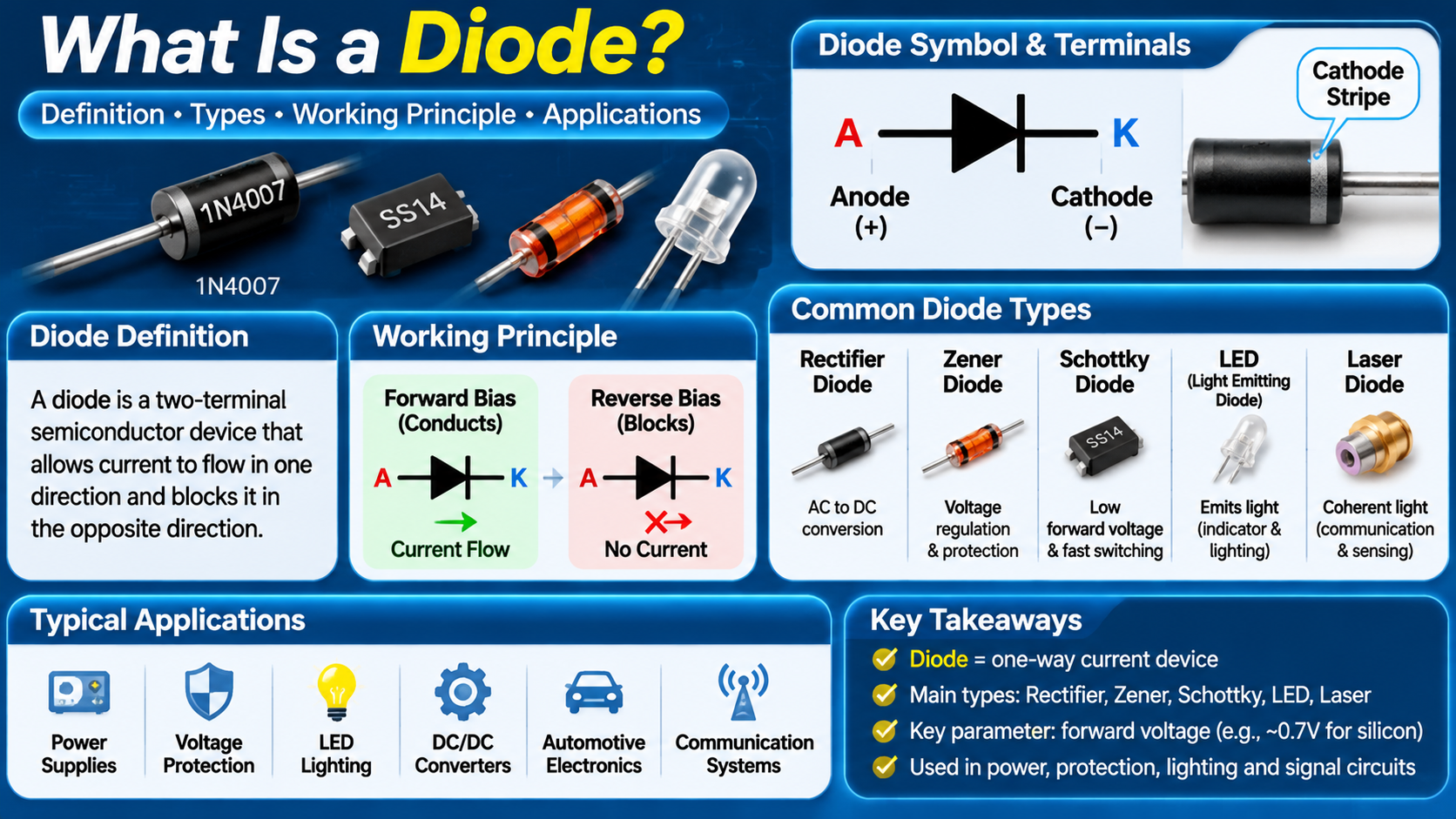
For example, a semiconductor diode does not conduct current in direct proportion to applied voltage across its entire operating range.
Similarly, an NTC thermistor changes resistance as its temperature changes.
Understanding these characteristics is important when designing temperature-sensing circuits, semiconductor interfaces, and electronic protection systems.
Ohm's Law and Electrical Power: Understanding Resistor Wattage
Ohm's Law is closely connected to electrical power calculations.
The basic electrical power formula is:
P = V × I
Where P represents electrical power in watts.
For an ohmic resistor, combining the power equation with Ohm's Law produces two additional formulas:
P = I2 × R
P = V2 / R
These formulas help engineers estimate resistor power dissipation.
Consider a 100Ω resistor connected across a 12V DC supply.
P = V2 / R
P = 122 / 100
P = 1.44W
The resistor dissipates 1.44 watts of electrical power as heat.
A standard 0.25W resistor would not be suitable for continuous operation under these conditions.
Engineers must select a resistor with an appropriate power rating and thermal margin, taking ambient temperature, mounting conditions, and manufacturer derating guidance into account.
Why Ohm's Law Matters in Modern Electronic Circuit Design
Modern electronic systems rely on accurate voltage, current, and resistance calculations to achieve reliable operation.
1. Resistor Selection
Engineers use Ohm's Law to determine resistor values for current limiting, biasing networks, voltage drops, and other circuit functions.
2. LED Lighting Circuits
LEDs require suitable current control to avoid excessive electrical stress. Series resistors are frequently used in simple LED circuits.
3. Microcontroller Systems
Microcontrollers commonly use pull-up resistors, pull-down resistors, and current-limiting resistors in digital interfaces.
4. Power Supply Design
Ohm's Law supports resistive load calculations, current-sensing circuits, and voltage-drop analysis.
5. Industrial Automation
Industrial control equipment uses resistive sensing networks and current measurement circuits for monitoring and control.
6. Electronic Troubleshooting
Technicians can compare measured voltage and current values with calculated expectations to identify abnormal circuit conditions.
How to Calculate an LED Current-Limiting Resistor Using Ohm's Law
One practical application of Ohm's Law is calculating a resistor for a simple LED circuit.
The formula is:
R = (Vsupply - VLED) / ILED
Where:
- Vsupply = Supply voltage
- VLED = Expected LED forward voltage
- ILED = Desired LED current
- R = Series resistance
Consider a circuit with a 5V power supply, an LED forward voltage of 2V, and a desired current of 10mA.
R = (5 - 2) / 0.01
R = 300Ω
A standard 330Ω resistor could be selected for a slightly lower nominal current.
Using 330Ω:
I = (5 - 2) / 330 ≈ 9.09mA
The resistor dissipates approximately 0.027W under these assumed conditions.
Actual LED current depends on LED forward-voltage variation, supply tolerance, temperature, and resistor tolerance.
Does Ohm's Law Apply to AC and DC Circuits?
Ohm's Law is commonly introduced using direct-current circuits containing fixed resistors.
However, related voltage-current relationships are also used in alternating-current analysis.
Ohm's Law in DC Circuits
For a simple DC circuit containing an ideal resistor:
V = I × R
This relationship directly connects voltage, current, and resistance.
Ohm's Law in AC Circuits
In sinusoidal steady-state AC analysis, capacitors and inductors introduce reactance and phase shifts.
The generalized phasor relationship is:
V = I × Z
Where Z represents complex impedance.
Impedance includes both resistive and reactive behavior.
For a purely resistive AC load, the familiar relationship between RMS voltage, RMS current, and resistance remains valid.
For circuits containing capacitors and inductors, impedance and phase relationships must also be considered.
Common Ohm's Law Calculation Mistakes Engineers Should Avoid
Although Ohm's Law is straightforward, incorrect assumptions can produce inaccurate circuit calculations.
1. Incorrect Unit Conversion
Current values expressed in milliamperes must be converted into amperes when using standard SI units.
2. Ignoring Resistor Power Ratings
A resistor may have the correct resistance but an insufficient power rating for the application.
3. Applying Constant Resistance to Nonlinear Devices
Diodes, LEDs, and thermistors require appropriate models because their resistance is not constant across all operating conditions.
4. Ignoring Temperature Effects
Resistor values can change with temperature, especially in applications involving substantial self-heating.
5. Using Supply Voltage Instead of Component Voltage
The voltage used in Ohm's Law must be the voltage across the component being analyzed.
6. Ignoring Component Tolerance
Actual resistance can differ from nominal resistance within the manufacturer's specified tolerance range.
Accurate circuit design requires combining theoretical calculations with realistic component specifications.
Engineering Outlook: Why Ohm's Law Remains Important for Future Electronics
As electronic systems become more sophisticated, fundamental circuit calculations remain essential.
Applications such as electric vehicles, renewable energy equipment, industrial automation, embedded computing, and connected devices require careful electrical design.
Ohm's Law continues to support current measurement, resistor selection, voltage-drop analysis, and power dissipation calculations.
In high-density circuit boards, engineers must also consider conductor resistance, thermal performance, and voltage losses across PCB traces.
For current-sensing applications, low-value resistors are commonly used to convert current into measurable voltage.
The relationship is:
Vsense = I × Rsense
For example, a 0.01Ω sensing resistor carrying 5A produces:
Vsense = 5 × 0.01 = 0.05V
The resulting voltage is 50mV.
This technique is widely used in battery management, motor control, power conversion, and current monitoring.
Although simulation software can automate complex circuit analysis, understanding the underlying electrical relationships remains essential for interpreting results and identifying design problems.
Frequently Asked Questions About Ohm's Law
What is Ohm's Law in simple terms?
Ohm's Law explains the relationship between voltage, current, and resistance. For a fixed resistance, current increases when voltage increases.
What is the formula for Ohm's Law?
The standard formula is V = I × R, where V represents voltage, I represents current, and R represents resistance.
How do you calculate current using Ohm's Law?
Divide the voltage across a resistor by its resistance using I = V / R.
How do you calculate resistance?
Resistance can be calculated using R = V / I, where voltage is divided by nonzero current.
What is the unit of electrical resistance?
The SI unit of electrical resistance is the ohm, represented by the symbol Ω.
What is the difference between ohmic and non-ohmic devices?
Ohmic devices exhibit an approximately linear voltage-current relationship under specified conditions. Non-ohmic devices exhibit nonlinear electrical behavior.
Is an LED an ohmic device?
No. An LED is a semiconductor diode with a nonlinear voltage-current relationship. A simple constant-resistance model does not accurately describe its full operating behavior.
What is the relationship between voltage and current?
For an ideal fixed resistor, current is directly proportional to voltage. Doubling the applied voltage doubles the current when resistance remains constant.
Does Ohm's Law apply to AC circuits?
Yes. The familiar relationship applies to purely resistive AC circuits. More complex AC circuits use impedance and phasor analysis.
What is the difference between resistance and impedance?
Resistance describes the resistive component of electrical opposition, while impedance also accounts for reactive effects and phase relationships in AC circuits.
How is Ohm's Law used in resistor selection?
Engineers use Ohm's Law to calculate resistance values, expected current, and voltage drops. They also evaluate power dissipation, tolerance, and thermal requirements.
Why is Ohm's Law important in electronics?
Ohm's Law supports circuit analysis, electrical measurements, resistor selection, current sensing, power calculations, and troubleshooting.
Conclusion: Understanding Ohm's Law Improves Electronic Circuit Design
Ohm's Law remains one of the most important principles in electrical and electronic engineering.
The relationship V = I × R provides a practical method for understanding voltage, current, and resistance in ohmic circuit elements.
From selecting resistors and calculating LED current to evaluating power dissipation and designing current-sensing networks, Ohm's Law supports many everyday engineering decisions.
However, real electronic systems require more than ideal calculations. Component tolerance, temperature effects, nonlinear semiconductor behavior, and operating conditions must also be considered.
By combining Ohm's Law with accurate component datasheets and practical circuit analysis, engineers can improve design reliability and make better electronic component selections.
Technical References
- OpenStax - Ohm's Law: Resistance and Simple Circuits
- All About Circuits - Ohm's Law and the Relationship Between Voltage, Current, and Resistance
Editorial note: This article provides an educational engineering analysis of Ohm's Law and its applications. It is not an announcement of a new electronic component or a verified market trend. Calculation examples use simplified circuit models unless otherwise stated. Actual designs should be verified using manufacturer datasheets, operating conditions, thermal requirements, and applicable safety standards.