

MLCC 2026 Guide: Ceramic Capacitors, Price, Ordering, AI Demand and Market Trends
Contents
- What Is an MLCC?
- Why MLCC Is So Important in Modern Electronics
- MLCC Capacitor: What Does It Actually Do?
- MLCC Ceramic Technology Explained Simply
- MLCC 2026: Why AI Is Changing Demand
- AI and MLCC Demand: The Hidden Connection
- MLCC Market in 2026: A More Selective Market
- MLCC Price: Why Is It Difficult to Give One Number?
- MLCC Ordering: What Should Buyers Check?
- MLCC Online Ordering: Is It Better?
- MLCC Manufacturers: Murata, Vishay and Other Suppliers
- Vishay Intertechnology MLCC: When Does It Make Sense?
- MLCC Shortage: Is There Really a Shortage?
- How AI Could Affect MLCC Prices
- What Is an MLCC Price Book?
- MLCC Michigan: An Important Search-Intent Difference
- What Is "MLCC Liquor Order"?
- What Is MLCC OLO?
- MLCC Liquor Order Online vs MLCC Online Ordering
- What Is the Michigan MLCC Price Book?
- MLCC vs Other Capacitor Technologies
- How to Choose an MLCC for AI Hardware
- How to Reduce MLCC Supply Risk
- Why MLCC Specification Matters More Than the Logo
- What Will Drive MLCC Demand After 2026?
- MLCC Procurement Strategy for 2026
- Frequently Asked Questions About MLCC
- Final Thoughts: The Real Value of MLCC in 2026
MLCC, short for Multilayer Ceramic Capacitor, is one of the smallest and most widely used electronic components in modern hardware. It is easy to overlook because a single MLCC may be only a few millimeters long, yet thousands of these tiny ceramic capacitors can appear across the electronics ecosystem.
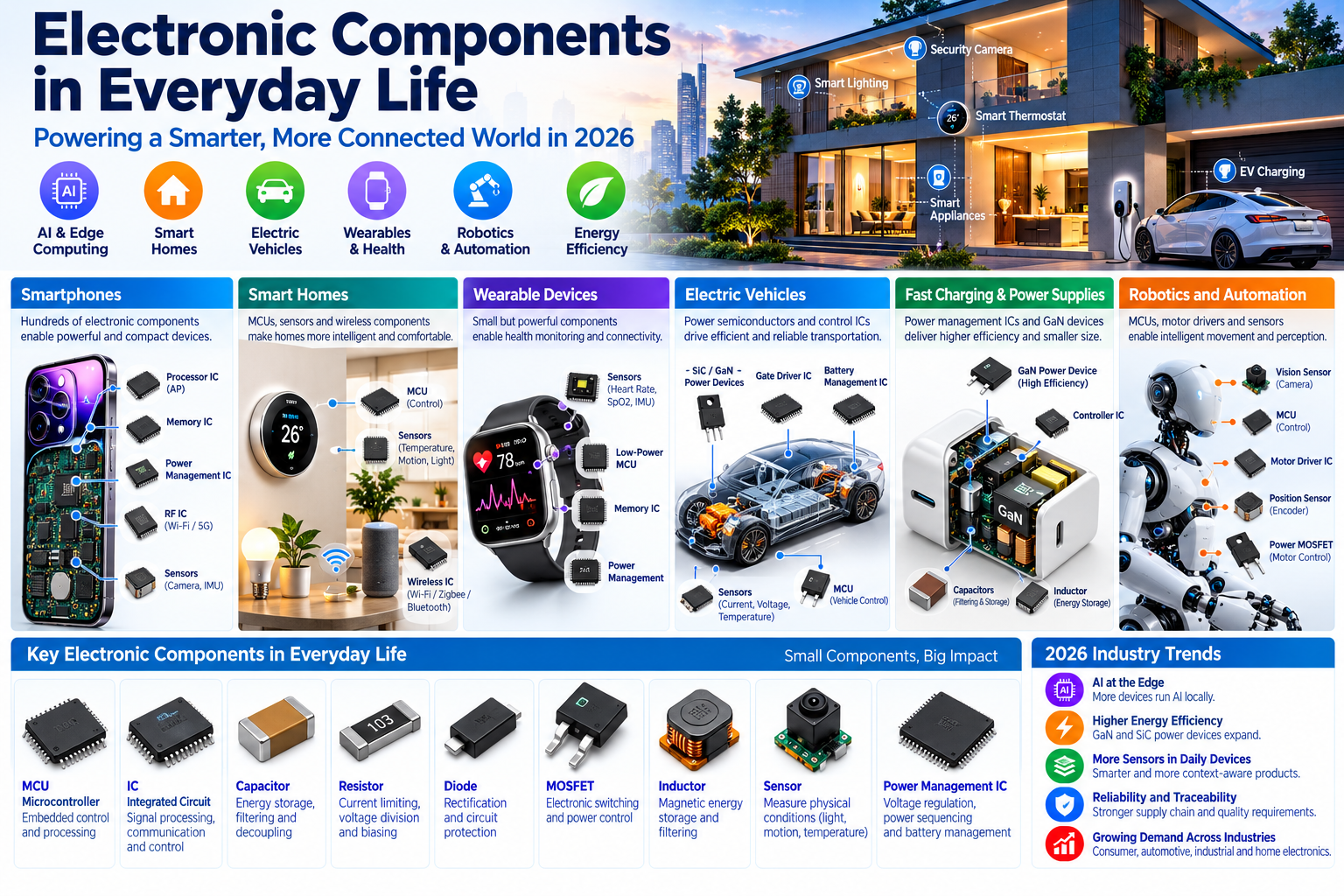
Smartphones, computers, servers, automotive electronics, industrial controllers, networking equipment, power supplies, medical equipment, and many other products depend on capacitors to control noise, stabilize voltage, filter signals, and support reliable circuit operation.
In 2026, MLCC is also becoming a more interesting market topic because electronics demand is changing. Artificial intelligence infrastructure, high-performance computing, electric vehicles, advanced networking, and increasingly compact electronic systems are changing the type of capacitor that manufacturers need. The important question is no longer simply "How many MLCCs are needed?" It is also "Which MLCC specifications are becoming difficult to source?"
This article explains MLCC technology in simple English and looks at the 2026 market from a practical purchasing perspective. It also covers MLCC price, ordering, manufacturers, shortages, AI demand, ceramic technology, Murata and Vishay Intertechnology MLCC products, and several unusual search terms such as MLCC liquor order, MLCC Michigan, MLCC OLO, and Michigan MLCC price book.
What Is an MLCC?
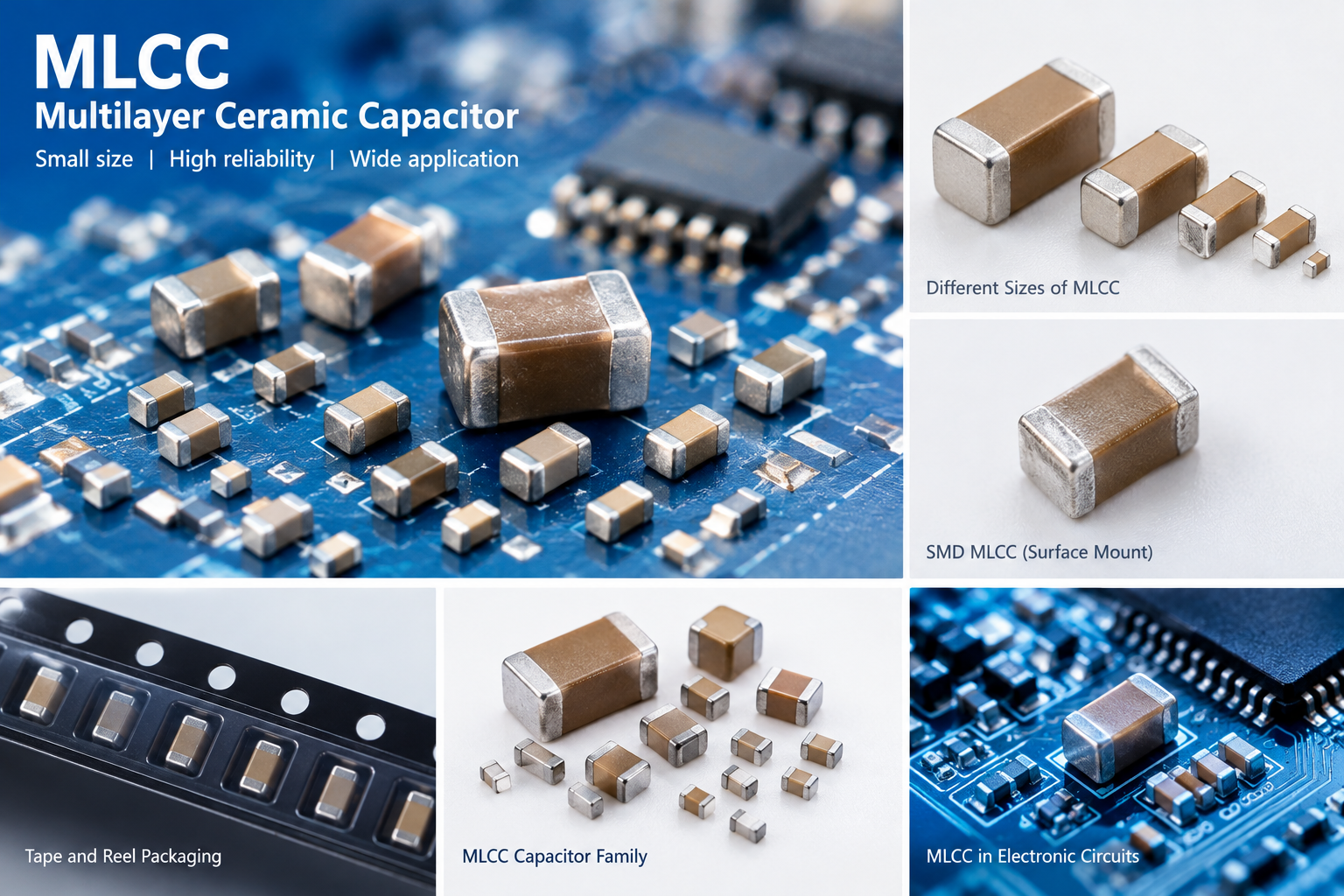
An MLCC is a multilayer ceramic capacitor. It is a passive electronic component made by stacking multiple layers of ceramic dielectric and conductive electrodes.
The basic idea is simple. A capacitor stores electrical energy and helps control changes in voltage. An MLCC uses many very thin internal layers to achieve useful capacitance in a very small package.
This multilayer structure is the main reason MLCCs are so important in modern electronics. Instead of using a large component, engineers can place a tiny surface-mount capacitor close to an integrated circuit or power device.
The result is a component that combines:
- Small physical size
- High component density
- Fast electrical response
- Low parasitic effects in many applications
- High-volume manufacturing capability
- Wide capacitance and voltage options
Vishay, for example, describes its ceramic capacitor portfolio as including multilayer and single-layer technologies, with MLCC products available for different voltage, dielectric, packaging, and application requirements.
Why MLCC Is So Important in Modern Electronics
The biggest reason for the popularity of the MLCC is not simply its low price. The real advantage is that it solves several electrical problems without taking much board space.
Consider a modern processor. A processor can change its current demand extremely quickly. When this happens, the power supply cannot always respond instantly. Local decoupling capacitors help provide short bursts of current and reduce unwanted voltage movement.
This is one reason MLCCs are commonly placed close to IC power pins.
The same basic concept appears in many other products:
- Smartphones
- AI servers
- Graphics systems
- Networking equipment
- Automotive control units
- Electric vehicle electronics
- Industrial automation systems
- Telecommunications equipment
- Consumer electronics
- Medical electronics
The more electronics a product contains, the more opportunities there are for MLCCs to become part of the design.
MLCC Capacitor: What Does It Actually Do?
The phrase MLCC capacitor is technically repetitive because the "C" in MLCC already stands for capacitor. However, people frequently search for "MLCC capacitor" because they want to distinguish multilayer ceramic capacitors from other capacitor technologies.
An MLCC can perform several different functions depending on its position in a circuit.
Decoupling
Decoupling is one of the most common uses. An MLCC placed near an IC can help reduce high-frequency noise on a power rail.
Filtering
MLCCs can work with resistors, inductors, and other capacitors to remove unwanted signal components or electrical noise.
Energy Support
An MLCC can temporarily provide stored electrical energy when a circuit experiences a rapid current demand.
Signal Applications
Specific ceramic dielectric types can be useful in RF and high-frequency applications because of their electrical characteristics.
Safety and High-Voltage Applications
Specialized MLCCs are also available for applications that require higher voltage ratings, safety certification, high-frequency performance, or stronger mechanical resistance.
Vishay's ceramic portfolio, for example, includes MLCC products for high-frequency, automotive, safety-certified, high-voltage, and other specialized applications.
MLCC Ceramic Technology Explained Simply
The word ceramic is important because the dielectric material strongly affects how an MLCC behaves.
Two commonly discussed dielectric families are C0G/NP0 and X7R.
C0G/NP0 is known for strong stability and relatively low capacitance change with temperature and voltage. It is often selected when electrical stability is more important than achieving the highest capacitance in the smallest package.
X7R provides much higher capacitance density and is widely used for power supply decoupling and general electronic circuits. However, engineers need to consider capacitance changes caused by DC bias, temperature, aging, and other operating conditions.
This leads to an important purchasing lesson: the capacitance printed in a part number is not always the capacitance the circuit will experience under every operating condition.
For engineering selection, the actual voltage, temperature, frequency, tolerance, dielectric, package size, and DC-bias behavior should be checked.
MLCC 2026: Why AI Is Changing Demand
One of the most important MLCC market topics in 2026 is artificial intelligence.
AI servers are not simply faster versions of ordinary computers. They contain powerful processors, accelerators, memory systems, high-speed networking, and complex power-delivery networks.
More processing power means more power-management complexity. More power-management complexity can create additional demand for carefully selected capacitors.
Recent 2026 market reporting has highlighted structural demand for high-end and higher-capacitance MLCCs connected with AI servers and custom computing platforms. At the same time, traditional consumer markets can behave differently, creating a market where some MLCC categories are tight while others remain more balanced.
This is a key point for buyers:
"MLCC shortage" does not necessarily mean every MLCC is difficult to buy.
A shortage can be highly specific to capacitance, voltage, case size, dielectric, automotive qualification, reliability level, or application.
For example, a common general-purpose capacitor may remain widely available while a particular high-capacitance automotive-grade or high-voltage MLCC has much longer lead times.
AI and MLCC Demand: The Hidden Connection
The connection between AI and MLCC is easy to misunderstand.
AI does not directly "consume" capacitors as a software product. Instead, AI increases demand for the hardware infrastructure needed to run AI workloads.
That infrastructure includes:
- AI accelerators
- CPUs
- High-bandwidth memory systems
- Network switches
- Power conversion systems
- Server motherboards
- Data-center power equipment
- Cooling and control electronics
Each of these systems contains many electronic circuits. Those circuits require passive components, including capacitors.
This is why AI can influence the MLCC market even though MLCCs are not "AI chips."
MLCC Market in 2026: A More Selective Market
The MLCC market should not be viewed as one single market.
There are many different product categories based on:
- Capacitance
- Voltage
- Dielectric
- Case size
- Temperature rating
- Automotive qualification
- Reliability requirements
- High-frequency characteristics
- Mechanical design
- Safety certification
This creates an interesting market structure.
A buyer may hear that MLCC supply is tight and immediately expect every capacitor to become expensive. In reality, pricing can move very differently between individual specifications.
That is why professional purchasing should focus on the exact manufacturer part number rather than only the word "MLCC."
MLCC Price: Why Is It Difficult to Give One Number?
Searching for MLCC price sounds simple, but an MLCC does not have one universal price.
Consider two capacitors:
- One is a basic 0402 general-purpose capacitor.
- The other is a high-reliability automotive MLCC with a larger case size, higher voltage, tighter specifications, and specialized termination.
Both are MLCCs, but their production requirements and market values can be very different.
The price can depend on:
- Capacitance
- Voltage rating
- Package size
- Dielectric
- Tolerance
- Temperature characteristics
- Manufacturer
- Automotive qualification
- Order quantity
- Packaging
- Lead time
- Supply conditions
- Factory allocation
Therefore, a reliable MLCC price comparison should always compare identical or technically equivalent specifications.
MLCC Ordering: What Should Buyers Check?
MLCC ordering should begin with engineering requirements rather than price.
A good purchasing process looks like this:
- Confirm capacitance.
- Confirm voltage rating.
- Confirm dielectric.
- Confirm tolerance.
- Confirm case size.
- Confirm temperature range.
- Confirm termination requirements.
- Confirm qualification requirements.
- Confirm packaging.
- Check manufacturer and exact part number.
- Compare available stock.
- Compare lead time and price.
This approach reduces the risk of buying a component that looks similar but does not perform correctly in the circuit.
MLCC Online Ordering: Is It Better?
MLCC online ordering can make sourcing faster because buyers can search multiple manufacturers, compare stock, review datasheets, and request quotations without contacting every supplier individually.
However, online availability should not automatically be interpreted as guaranteed supply.
A website may show stock that is:
- Limited in quantity
- Held at another warehouse
- Subject to allocation
- Available only in a different packaging format
- Older production stock
- Not immediately available for shipment
For low-volume engineering samples, online ordering can be extremely convenient. For production purchasing, buyers should confirm actual available quantity, date code, packaging, traceability, and delivery schedule.
MLCC Manufacturers: Murata, Vishay and Other Suppliers
When people search for MLCC manufacturer, they are usually trying to identify reliable sources rather than simply find the cheapest component.
Murata is one of the best-known names in the MLCC market and has a very broad ceramic capacitor portfolio.
Vishay Intertechnology is another important manufacturer with a broad ceramic capacitor portfolio, including multilayer SMD products and specialized MLCC technologies.
Vishay's current product information shows MLCC families covering different case sizes, dielectric materials, voltage ratings, capacitance ranges, and specialized applications.
Other major manufacturers also serve different portions of the market. Depending on the application, buyers may evaluate manufacturers such as Samsung Electro-Mechanics, TDK, Yageo, KEMET, AVX, Taiyo Yuden, Walsin, and others.
The right manufacturer depends on the product requirement. A supplier that is excellent for consumer electronics may not be the best choice for an automotive or high-reliability application.
Vishay Intertechnology MLCC: When Does It Make Sense?
The search phrase Vishay Intertechnology MLCC is useful because Vishay's ceramic portfolio is broader than a single general-purpose MLCC family.
Vishay offers multilayer ceramic products across different application categories, including automotive, high-frequency, safety-certified, high-voltage, and other specialized designs.
For a buyer, this means the correct selection should start with the electrical requirement instead of simply asking for "a Vishay MLCC."
A better RFQ might specify:
10 nF, 50 V, X7R, 0603, ±10%, automotive grade, required quantity, required packaging.
This gives the supplier enough information to identify the correct part.
MLCC Shortage: Is There Really a Shortage?
The answer requires more detail than "yes" or "no."
In 2026, market conditions can be different between MLCC categories. Recent industry reporting has pointed to tight supply in some higher-end and higher-capacitance MLCC segments driven by AI infrastructure, while weaker demand in some traditional consumer markets creates a more mixed picture.
This is best described as a selective shortage rather than a universal shortage.
The practical implication is important.
If your company waits until a specific high-demand MLCC becomes scarce, changing to another manufacturer may not be easy. The alternative part may have different electrical behavior, qualification status, case size, or availability.
Therefore, procurement teams should identify critical MLCCs before the shortage appears on the production line.
How AI Could Affect MLCC Prices
AI demand can influence MLCC prices indirectly through capacity allocation.
Manufacturers have limited production capacity. If certain high-value specifications become more attractive because of AI-server demand, production resources may move toward those categories.
This does not mean every MLCC price will rise at the same speed.
Instead, buyers may see a more fragmented market:
- Some common parts remain competitive.
- Some high-capacitance parts become tighter.
- Automotive-grade parts may require longer planning.
- Specialized high-voltage products may have fewer qualified suppliers.
- Popular AI-related specifications may receive stronger demand.
For purchasing managers, this makes specification-level forecasting more useful than general market headlines.
What Is an MLCC Price Book?
The phrase MLCC price book can be confusing because "price book" is not normally a universal technical document for ceramic capacitors.
In the electronics industry, an MLCC price list or quotation sheet may contain part numbers, specifications, packaging, quantity breaks, and prices. But these documents are usually supplier-specific or distributor-specific rather than one global MLCC price book.
For this reason, buyers searching for an MLCC price book should clarify whether they want:
- A distributor price list
- A manufacturer's quotation
- A historical pricing reference
- A BOM cost database
- A supplier-specific price file
Without that clarification, "MLCC price book" can refer to very different documents.
MLCC Michigan: An Important Search-Intent Difference
One of the most interesting keywords in your list is MLCC Michigan.
Here the problem is not electronics. The acronym MLCC also refers to the Michigan Liquor Control Commission.
This creates two completely different meanings:
| MLCC Meaning | Industry | Typical Search Terms |
|---|---|---|
| Multilayer Ceramic Capacitor | Electronics | MLCC capacitor, MLCC price, MLCC manufacturer, MLCC ordering |
| Michigan Liquor Control Commission | Liquor regulation and ordering | MLCC liquor, MLCC OLO, MLCC liquor order, Michigan MLCC price book |
This distinction is extremely important for SEO.
A search engine needs context to determine whether "MLCC" means an electronic component or a Michigan government agency. That is why combining both meanings in one article without explaining the difference can create poor search intent.
What Is "MLCC Liquor Order"?
MLCC liquor order does not refer to ordering MLCC capacitors.
In Michigan, MLCC can refer to the Michigan Liquor Control Commission, and its official online system supports liquor ordering for eligible retailer licensees.
The Michigan government describes its OLO system as the Online Liquor Ordering system and explains that registered licensees can search products, create orders, edit orders, and submit orders electronically.
Therefore, the phrase MLCC liquor order belongs to a completely different search category from MLCC capacitor.
What Is MLCC OLO?
MLCC OLO means the Michigan Liquor Control Commission's Online Liquor Ordering system.
The official Michigan information explains that the system is intended for eligible licensees and provides functions for placing, editing, copying, and cancelling liquor orders. It also allows users to search product information and review previous orders.
This has nothing to do with multilayer ceramic capacitors.
For SEO, this is a perfect example of why acronyms require entity disambiguation. The same four letters can represent two unrelated industries.
MLCC Liquor Order Online vs MLCC Online Ordering
The phrases MLCC liquor order online and MLCC online ordering are likely to attract users looking for Michigan's liquor-ordering system rather than electronic components.
The official Michigan system requires an appropriate liquor license and registered access. It is not a general public shopping platform for electronic components or alcohol.
This distinction should be made clear when building SEO content around the keyword "MLCC."
For electronics buyers, the correct terms are more likely to be:
- MLCC ordering
- MLCC online ordering
- MLCC capacitor supplier
- MLCC distributor
- MLCC manufacturer
- MLCC price
For Michigan liquor licensees, the search intent is different:
- MLCC liquor order
- MLCC liquor order online
- MLCC OLO
- Michigan MLCC price book
- MLCC liquor ordering
What Is the Michigan MLCC Price Book?
The phrase Michigan MLCC price book is another example of acronym ambiguity.
Michigan's official Liquor Control Commission publishes spirit price-book information for liquor products. The official page currently provides price-book files and new-item price lists, along with information about online ordering.
The Michigan price book contains information such as liquor code, brand name, proof, package size, base price, licensee price, and minimum shelf price.
So if someone searches for MLCC price book together with Michigan or liquor, they are almost certainly not looking for capacitor pricing.
This distinction is valuable for both users and search engines because it prevents an electronics article from incorrectly presenting a liquor price book as an MLCC capacitor price database.
MLCC vs Other Capacitor Technologies
MLCCs are not automatically the best capacitor for every circuit.
Engineers may also consider:
- Aluminum electrolytic capacitors
- Tantalum capacitors
- Polymer capacitors
- Film capacitors
- Single-layer ceramic capacitors
MLCCs are especially strong when small size, high-frequency response, and surface-mount assembly are important.
Electrolytic capacitors may provide much higher capacitance in certain applications. Film capacitors can be attractive when stability, pulse performance, or AC characteristics are important.
Therefore, MLCC vs capacitor is not really a fair comparison. MLCC is itself a type of capacitor.
A better question is:
"When should I choose an MLCC instead of another capacitor technology?"
How to Choose an MLCC for AI Hardware
AI hardware creates demanding electrical environments, but the selection process still follows basic engineering principles.
Start with the circuit rather than the market trend.
Check:
- Required capacitance
- DC operating voltage
- Transient voltage
- DC bias effect
- Temperature
- Frequency
- ESR and ESL requirements
- Mechanical stress
- Package size
- Reliability requirements
Then evaluate availability.
A technically excellent MLCC that cannot be purchased in sufficient quantity is not a practical production solution.
How to Reduce MLCC Supply Risk
The best supply-chain strategy is not simply to find a cheaper supplier after a shortage begins.
A stronger approach is to design supply flexibility into the procurement process.
1. Identify Critical MLCCs
Not every capacitor deserves the same purchasing attention. Identify parts with long lead times, strict qualification, unusual capacitance values, or limited manufacturers.
2. Approve Alternatives Early
Do not wait for a shortage before evaluating second sources. An alternative should be electrically and mechanically verified before production use.
3. Separate Technical Equivalence from Commercial Equivalence
Two parts may have the same capacitance and voltage but different reliability or mechanical characteristics.
4. Monitor Date Codes and Traceability
For long-term production, traceability is important, especially when components are sourced through multiple channels.
5. Avoid Panic Buying
When market rumors appear, uncontrolled buying can create unnecessary inventory. A better approach is to understand exactly which MLCC category is actually constrained.
Why MLCC Specification Matters More Than the Logo
A famous manufacturer does not automatically make every part suitable for every application.
Likewise, a less famous manufacturer does not automatically mean poor quality.
The correct evaluation should include:
- Datasheet performance
- Qualification
- Reliability
- Production consistency
- Supply capacity
- Quality system
- Traceability
- Price
- Delivery performance
For automotive, industrial, medical, aerospace, and other demanding applications, qualification requirements may be more important than a small unit-price difference.
What Will Drive MLCC Demand After 2026?
The future of MLCC demand will probably not depend on one single product category.
Several long-term trends can support demand:
- Artificial intelligence infrastructure
- Data centers
- Electric vehicles
- ADAS and automotive electronics
- 5G and future communication systems
- Industrial automation
- Robotics
- Edge computing
- Consumer electronics miniaturization
- Power-management complexity
The more electronics move into products and infrastructure, the more important passive-component planning becomes.
However, future demand should not be interpreted as a guarantee that every MLCC will become more expensive. Capacity expansion, technology improvements, inventory cycles, and changes in consumer demand can all affect pricing.
MLCC Procurement Strategy for 2026
If I had to reduce the 2026 MLCC procurement strategy to five rules, they would be:
- Buy the specification, not just the name.
- Monitor high-demand categories separately.
- Qualify alternatives before they are urgently needed.
- Separate market rumors from actual supplier data.
- Balance price, quality, availability, and long-term supply.
This approach is more reliable than trying to predict the entire MLCC market with one simple price forecast.
Frequently Asked Questions About MLCC
What does MLCC stand for?
MLCC stands for Multilayer Ceramic Capacitor. It is a passive electronic component made from alternating ceramic dielectric and conductive electrode layers.
What is an MLCC capacitor used for?
MLCCs are widely used for decoupling, filtering, noise reduction, energy support, and signal-related applications in electronic circuits.
Is MLCC a ceramic capacitor?
Yes. MLCCs are a type of ceramic capacitor that uses multiple internal dielectric and electrode layers.
Why are MLCCs important for AI?
AI infrastructure uses powerful processors, accelerators, memory, networking, and complex power-delivery systems. These systems can require large numbers of carefully selected passive components, including MLCCs.
Why does MLCC price vary so much?
Price depends on capacitance, voltage, dielectric, case size, tolerance, qualification, manufacturer, packaging, quantity, availability, and supply conditions.
What is MLCC ordering?
In electronics, MLCC ordering means purchasing multilayer ceramic capacitors based on their required specifications and part numbers.
What is MLCC OLO?
In Michigan, MLCC OLO refers to the Michigan Liquor Control Commission's Online Liquor Ordering system. It is unrelated to electronic MLCC capacitors.
What is an MLCC liquor order?
"MLCC liquor order" refers to liquor ordering through the Michigan Liquor Control Commission, not ordering multilayer ceramic capacitors.
What is the Michigan MLCC price book?
It refers to Michigan Liquor Control Commission price-book information for spirits. It is not an MLCC capacitor price list.
Is Vishay an MLCC manufacturer?
Yes. Vishay Intertechnology offers multilayer ceramic capacitor products as part of its broader ceramic capacitor portfolio.
Is Murata an MLCC manufacturer?
Yes. Murata is a major manufacturer associated with multilayer ceramic capacitors and other electronic components.
Should I buy MLCCs online?
Online ordering can be convenient for samples and production sourcing, but buyers should confirm actual stock, exact part number, packaging, date code, traceability, price, and delivery conditions before placing important orders.
Final Thoughts: The Real Value of MLCC in 2026
The most interesting thing about the MLCC market is that its importance is much larger than the physical size of the component.
An MLCC may look like a tiny rectangle on a circuit board, but it supports the electrical stability of processors, communication systems, automotive controllers, servers, power supplies, and countless other electronic products.
In 2026, AI and high-performance computing are making some MLCC categories more strategically important. At the same time, traditional electronics markets can move in different directions. This creates a market where specification, application, and supply chain matter more than simple market-wide price predictions.
For buyers, the best strategy is therefore not to ask only, "What is the MLCC price?" Instead, ask:
Which MLCC specification do I need, which manufacturers can supply it, how stable is the supply, what alternatives are already qualified, and what will this component cost over the entire production cycle?
There is also a valuable SEO and information lesson hidden inside the keyword itself. MLCC does not always mean multilayer ceramic capacitor. Searches such as MLCC Michigan, MLCC liquor, MLCC liquor order, MLCC OLO, and Michigan MLCC price book belong to the Michigan Liquor Control Commission ecosystem, while MLCC capacitor, MLCC manufacturer, MLCC ordering, MLCC price, Murata MLCC, and Vishay Intertechnology MLCC belong to the electronics industry.
Understanding that difference creates better content, better search results, and better answers for users.
For electronics professionals, however, one conclusion remains clear: MLCCs will continue to be a small component with a very large role in the future of electronic design.