

STM32F405RGT6: Applications, Replacement, Equivalent, Price and Market Outlook
Contents
STM32F405RGT6: Applications, Replacement, Equivalent, Price and Market Outlook
The STM32F405RGT6 remains one of the most widely recognized members of the STM32F4 family. Although it is not a newly released microcontroller, it continues to attract attention from engineers, OEMs, developers, and electronic component buyers because it combines a 168 MHz Arm Cortex-M4 core, 1 MB of Flash memory, 192 KB of SRAM, a rich set of peripherals, and a mature development ecosystem.
For engineers searching for STM32F405RGT6 datasheet, STM32F405RGT6 applications, STM32F405RGT6 replacement, or STM32F405RGT6 equivalent, the key question is not simply how fast the MCU is. The more important question is why this mature MCU is still used in new products and existing designs, and what engineers should consider when selecting an alternative.
What Is STM32F405RGT6?
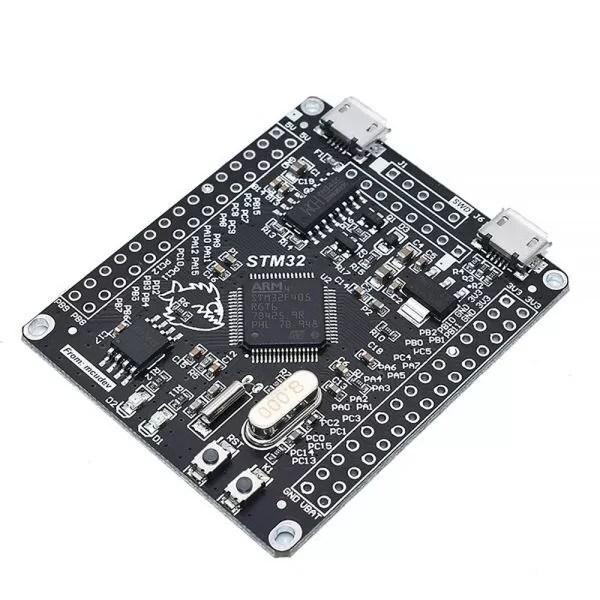
STM32F405RGT6 is a high-performance 32-bit microcontroller from STMicroelectronics and belongs to the STM32F4 family. It uses an Arm Cortex-M4 core with a floating-point unit and DSP instructions and can operate at up to 168 MHz.
According to STMicroelectronics, the STM32F405 family provides up to 1 MB of Flash memory and up to 192 KB of SRAM. The STM32F405RGT6 uses a 64-pin LQFP package with a 10 × 10 mm body size. Its supply voltage range is 1.8 V to 3.6 V, and the industrial operating temperature range is -40°C to +85°C.
The combination is important because many embedded products do not need an extremely powerful processor. Instead, they need a reliable MCU with enough processing power, memory, communication interfaces, timers, ADC resources, and software support.
STM32F405RGT6 Key Specifications
| Parameter | STM32F405RGT6 |
|---|---|
| Manufacturer | STMicroelectronics |
| MCU Family | STM32F4 |
| Core | Arm Cortex-M4 |
| Maximum CPU Frequency | 168 MHz |
| Flash Memory | 1 MB |
| SRAM | 192 KB |
| Package | 64-LQFP |
| Package Size | 10 × 10 mm |
| Supply Voltage | 1.8 V to 3.6 V |
| Operating Temperature | -40°C to +85°C |
| Connectivity | CAN, I2C, SPI, UART/USART, USB OTG and others |
| ADC | 12-bit ADC resources |
| DAC | 12-bit DAC resources |
| Mounting | Surface Mount |
Current distributor listings also confirm the 168 MHz Cortex-M4 architecture, 1 MB Flash, 192 KB RAM, 64-LQFP package, CAN, I2C, SPI, UART/USART and USB OTG connectivity.
Why Is STM32F405RGT6 Still So Popular?
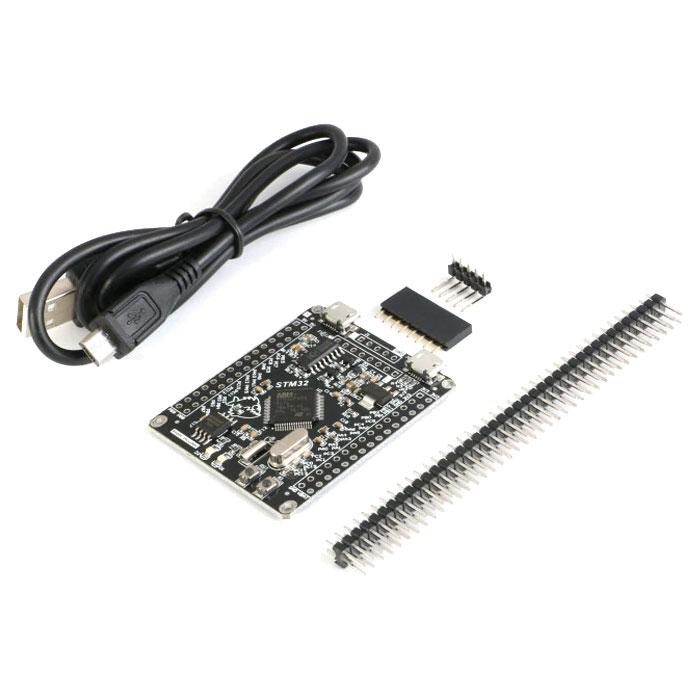
One of the most interesting characteristics of STM32F405RGT6 is that its market attention is not based on being the newest MCU. Instead, its demand is strongly connected to maturity, compatibility, performance, and the existing STM32 ecosystem.
1. A Practical Performance Level
The 168 MHz Cortex-M4 core gives STM32F405RGT6 enough processing capability for many medium-complexity embedded applications.
The Cortex-M4 architecture also provides DSP instructions and a single-precision floating-point unit. This is useful when an application needs mathematical calculations, digital filtering, sensor processing, motor-control algorithms, or other real-time processing.
For many products, moving to a significantly more powerful MCU would not necessarily provide enough additional value to justify the hardware and software redesign.
2. 1 MB Flash and 192 KB SRAM
Memory is another important reason why engineers continue to consider STM32F405RGT6.
A simple controller may work well with a small MCU. However, once a product includes USB communication, multiple sensors, communication protocols, an RTOS, data processing, bootloader functions, or a more complex application layer, memory requirements can grow quickly.
The combination of 1 MB Flash and 192 KB SRAM gives developers considerably more room than many entry-level microcontrollers.
3. Rich Peripheral Resources
STM32F405RGT6 is designed around more than CPU performance. It provides a broad collection of communication interfaces and peripherals.
Depending on the application, designers can use CAN, SPI, I2C, UART/USART, USB OTG, timers, PWM, ADC, DAC, DMA and other resources.
This makes the device suitable for systems where one MCU needs to communicate with multiple sensors, motor drivers, displays, external memory devices, industrial controllers, or other embedded modules.
4. Mature STM32 Development Ecosystem
The STM32F4 family has been used by engineers for many years. This creates an important advantage that cannot be measured only by CPU frequency.
Developers can find extensive documentation, development tools, software libraries, example projects, development boards, debugging resources, and community knowledge around the STM32 platform.
ST also continues to provide STM32F4 documentation and development resources. The current STM32F405/415 documentation page includes datasheets, application notes, reference manuals, programming manuals, STM32CubeF4 resources, and STM32Cube development tools.
For an engineering team that already understands the STM32 environment, staying within the STM32 ecosystem can reduce development and migration effort.
STM32F405RGT6 Applications
The search term STM32F405RGT6 applications is important for both engineers and purchasing teams because the real value of an MCU depends on how well it fits the target system.
Industrial Control
STM32F405RGT6 can be used in industrial controllers, data acquisition systems, sensor controllers, automation equipment, control panels, and other embedded industrial electronics.
Its combination of ADC, timers, PWM, CAN, SPI, I2C and UART/USART makes it practical for systems that need both real-time control and communication.
Motor Control
Motor-control applications are another important area.
Potential applications include BLDC motor controllers, servo-related equipment, robotic actuators, motion-control systems, gimbals, and industrial motor-control modules.
The Cortex-M4 DSP capability and floating-point support can be useful when control algorithms require real-time mathematical processing.
Robotics and Drones
STM32F4 devices have also become common in robotics and drone-related embedded systems.
A controller may need to communicate with inertial sensors, GPS modules, motor controllers, remote-control receivers, displays, and other peripherals. SPI, I2C, UART, timers, PWM and DMA can therefore be more important than simply having a higher CPU clock speed.
Measurement and Instrumentation
STM32F405RGT6 can also be considered for measurement equipment, data loggers, sensor platforms, test equipment, power-monitoring systems, and other embedded instruments.
The combination of analog peripherals, digital interfaces, memory and processing capability allows the MCU to handle both data collection and local processing.
USB Embedded Products
USB connectivity is another reason the STM32F405 family is useful in embedded equipment.
Applications can include USB-connected instruments, custom USB controllers, data acquisition devices, industrial interfaces, and other products that need a microcontroller to communicate with a host computer or USB peripheral.
STM32F405RGT6 Replacement and Equivalent
One of the most common search questions is STM32F405RGT6 replacement or STM32F405RGT6 equivalent.
However, an important engineering distinction must be made: a similar MCU is not automatically a pin-to-pin replacement.
A valid replacement evaluation should consider package, pin assignment, peripheral availability, memory, clock configuration, power requirements, boot configuration, software compatibility, electrical characteristics, and PCB layout.
STM32F407 as a Possible Migration Option
The STM32F407 family is one of the most obvious devices to evaluate when an application needs to remain close to the STM32F405 architecture.
Both families are based on the Cortex-M4 platform and operate at up to 168 MHz. However, the STM32F407 family provides additional capabilities such as Ethernet MAC and camera-interface functionality.
This means STM32F407 may be a useful migration candidate for some designs, but engineers should not assume that it is a universal direct replacement for STM32F405RGT6.
Other STM32F405 Package Options
Another approach is to remain within the STM32F405 family and evaluate other package or ordering options.
ST's current product information lists multiple STM32F405 variants, including STM32F405RG, STM32F405VG, STM32F405ZG and other package configurations. The correct choice depends on required I/O count, PCB space, package, and system architecture.
Newer STM32 Families as Migration Alternatives
For a completely new design, engineers may also evaluate newer STM32 families instead of choosing an older MCU automatically.
The decision may depend on requirements such as power consumption, security, processing performance, memory architecture, connectivity, package size, software compatibility, and expected product lifetime.
In other words, the best alternative is application-dependent rather than simply being the newest or fastest MCU.
STM32F405RGT6 Price and Supply Situation
The keyword STM32F405RGT6 price has strong commercial search intent because component buyers usually care about both unit cost and availability.
Current public distributor data shows that supply conditions can vary by ordering code and packaging format. For example, Mouser's current listing for STM32F405RGT6 shows no immediate stock and lists incoming quantities, while the displayed single-unit price is $12.50. DigiKey likewise currently shows the standard STM32F405RGT6 listing with no stock and a $12.50 single-unit price. These prices and stock positions can change quickly and should therefore be treated as snapshots rather than fixed market prices.
Interestingly, the related tape-and-reel ordering code STM32F405RGT6TR can have different channel inventory. DigiKey's current page shows limited stock for that ordering code and different quantity pricing.
This demonstrates why buyers should not evaluate MCU supply using only one distributor listing. Packaging suffixes, regional inventory, factory allocations, and distributor stock can all affect actual availability.
Why Supply Chain Matters for STM32F405RGT6
For an MCU, procurement risk is not only about price.
A lower-priced component may not be useful if it cannot be delivered on time or if its traceability is uncertain.
For production purchasing, buyers should evaluate:
- Manufacturer and original part number
- Package and ordering suffix
- Factory packaging
- Date code and lot traceability
- Authenticity
- Distributor source
- Lead time
- Available quantity
- Long-term supply planning
This is especially important for industrial equipment where a change of MCU can require firmware validation, hardware testing, EMC testing, and production qualification.
STM32F405RGT6 Market Outlook
The future market for STM32F405RGT6 should be viewed from both the existing-design market and the new-design market.
Existing Product Demand
The strongest long-term factor may be the large number of existing embedded designs that already use STM32F4 technology.
Industrial controllers, instruments, motor-control systems, robotics equipment, and other products can remain in production for many years. Once an MCU has been qualified in a product, replacing it can require significant engineering work.
Therefore, a mature MCU can continue to generate demand even when newer generations are available.
New Product Development
At the same time, new projects have more choices.
Engineers may evaluate newer STM32 families when they need lower power consumption, additional security features, newer connectivity options, higher processing performance, or a different memory architecture.
Therefore, STM32F405RGT6 should not be viewed as a product that must dominate every future MCU design. Its more realistic market position is a mature, high-performance Cortex-M4 platform that continues to fit a large number of embedded applications.
Is STM32F405RGT6 Still Worth Considering?
For an existing STM32F405 design, the answer depends mainly on supply, cost, lifecycle requirements, and technical requirements.
For a new design, the decision should be based on the complete system rather than the MCU name alone.
STM32F405RGT6 remains attractive when a project needs:
- 168 MHz Cortex-M4 processing
- DSP and floating-point capability
- 1 MB Flash
- 192 KB SRAM
- Rich communication interfaces
- CAN connectivity
- USB capability
- Multiple timers and PWM resources
- A mature STM32 software ecosystem
- A widely recognized 64-pin LQFP package
What Should Buyers Check Before Ordering?
Before purchasing STM32F405RGT6 in volume, buyers should confirm the exact ordering code rather than relying only on the base model name.
For example, STM32F405RGT6, STM32F405RGT6TR and other suffix variations can represent different packaging or delivery formats. The electrical device may be closely related, but the purchasing and packaging requirements can be different.
Buyers should also compare authorized distribution, independent distribution, available inventory, factory packaging, traceability, and delivery schedules.
STM32F405RGT6 SEO Keywords and Search Intent
For websites targeting Google search traffic, STM32F405RGT6 should be treated as a keyword cluster rather than a single keyword.
Primary keywords: STM32F405RGT6, STM32F405RGT6 datasheet, STM32F405RGT6 MCU, STM32F405RGT6 microcontroller, STM32F405RG
Specification keywords: STM32F405RGT6 specifications, STM32F405RGT6 pinout, STM32F405RGT6 168MHz, STM32F405RGT6 1MB Flash, STM32F405RGT6 192KB SRAM, STM32F405RGT6 LQFP64, STM32F405RGT6 Cortex-M4
Application keywords: STM32F405RGT6 applications, STM32F405RGT6 industrial applications, STM32F405RGT6 motor control, STM32F405RGT6 robotics, STM32F405RGT6 drone controller, STM32F405RGT6 USB applications, STM32F405RGT6 CAN applications
Replacement keywords: STM32F405RGT6 replacement, STM32F405RGT6 equivalent, STM32F405RGT6 alternative, STM32F405RGT6 substitute, STM32F405RGT6 replacement MCU, STM32F405RGT6 equivalent MCU, STM32F405RGT6 vs STM32F407
Procurement keywords: STM32F405RGT6 price, STM32F405RGT6 buy, STM32F405RGT6 supplier, STM32F405RGT6 distributor, STM32F405RGT6 stock, STM32F405RGT6 original, STM32F405RGT6 wholesale
Final Analysis
STM32F405RGT6 remains relevant because it solves a practical engineering problem: providing enough processing performance and peripheral resources without forcing designers into a much more complicated processor architecture.
Its 168 MHz Cortex-M4 core, 1 MB Flash, 192 KB SRAM, DSP and floating-point capabilities, rich interfaces, 64-pin LQFP package, and mature STM32 development ecosystem make it suitable for industrial control, motor control, robotics, measurement equipment, USB devices, and many other embedded applications. ST currently lists STM32F405RGT6 as an active product, while current distributor data demonstrates continued commercial activity around the part and its ordering variants.
For replacement planning, STM32F407 and other STM32 devices can be evaluated, but a replacement should always be validated against the complete hardware and software design rather than selected only from a specification table.
For procurement, the most important strategy is to combine technical compatibility with supply-chain verification. For new designs, engineers should also compare the STM32F405RGT6 against newer MCU platforms based on power, performance, security, connectivity, cost, and expected product lifetime.
That balance between mature technology and practical engineering requirements is the main reason why STM32F405RGT6 continues to attract attention in the embedded MCU market.